❤️ Outperforming $5,000 systems – and NOT for lovers of “flat” sound
I didn’t just buy these – I bought TWO pairs. As a veteran reviewer with 30+ years in the audiophile game, I can tell you: HiVi-Swans just pulled off the impossible. I got my hands on these a full week before ZeosPantera dropped his viral review, and my reaction was exactly the same: these are nuts.
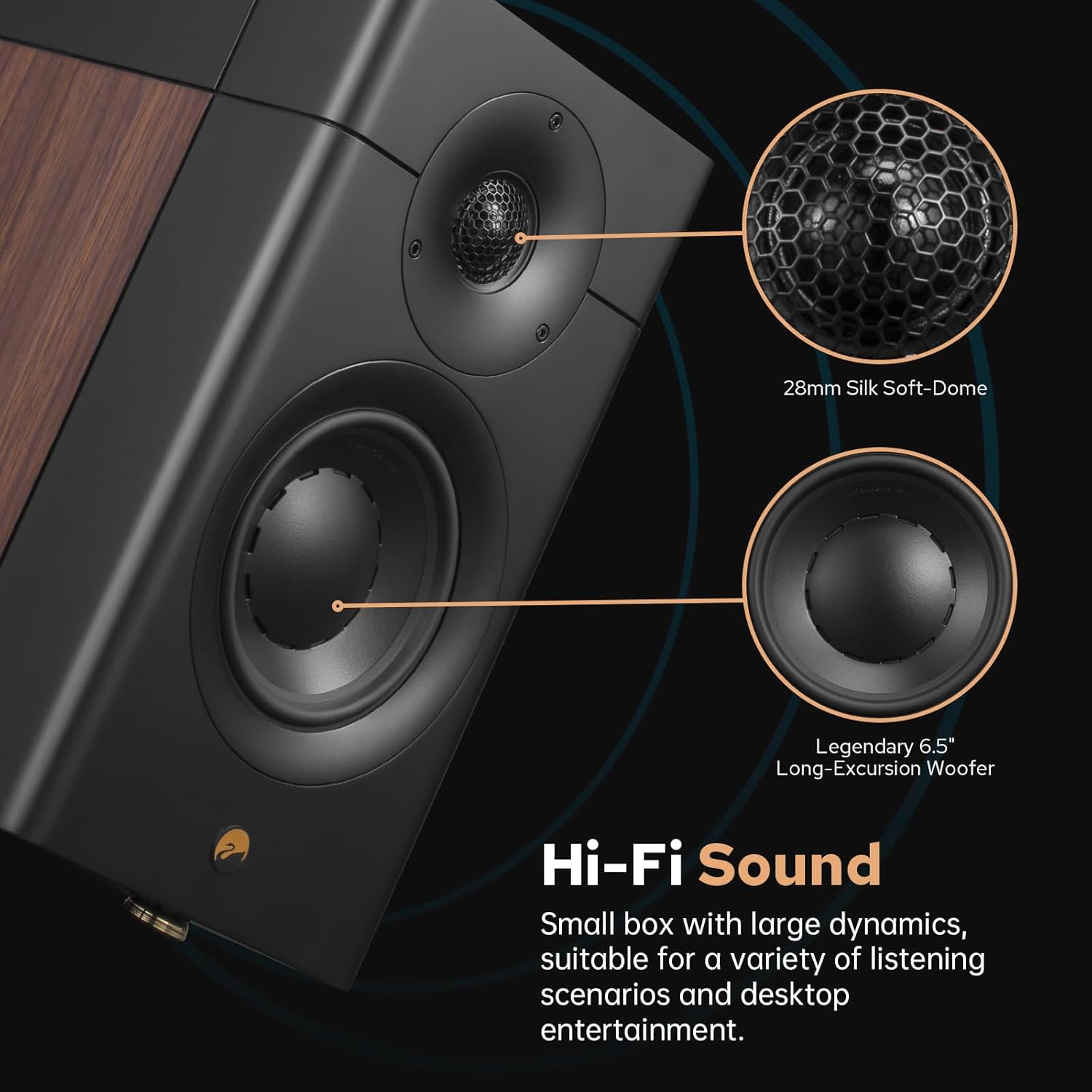
The sound: out of this world. The scale coming out of these babies is simply not from this planet. The 6.5″ woofer and 28mm German dome tweeter work in a synergy that defies physics – a 3D wall of sound with the emotional impact usually reserved for high-end floorstanders.
Read before buying: if you’re a “flat sound” purist who wants a boring, clinical, analytical frequency response – do NOT buy these. Go buy some dry studio monitors instead. Don’t buy these just to leave a 1-star review because they aren’t “flat.”
These speakers are for people who want EMOTION. They’re tuned for:
- Earth-shattering bass that makes you hunt for a hidden subwoofer
- Crystal-clear highs that make you smile every time a string is plucked
- Musicality that turns a listening session into an experience
The verdict from a pro: HiVi-Swans has disrupted the entire hi-fi industry with the D3.1 MKII. They don’t just play music – they deliver a performance. The size-to-performance ratio is completely broken: they sound massive, expensive and incredibly refined. Whether you’re in Chicago or anywhere else in the U.S., these are the gold standard. If you want to stop analyzing graphs and start enjoying your music again, this is your endgame. Check the current price on Amazon.
Watch the HiVi-Swans D3.1 MKII Review
After more than 30 years of hands-on experience with audio equipment, I’ve learned one thing: price does not always reflect performance. The HiVi-Swans D3.1 MKII is one of those rare products that truly proves it.
In this review, I’m not repeating specs or marketing claims. These speakers are part of my real-world testing environment, and what they deliver at this price point is honestly surprising.
Real-World Performance – Not Just Specifications
The HiVi-Swans D3.1 MKII is a passive bookshelf speaker built around a 6.5” woofer and a high-quality dome tweeter. On paper, that sounds standard. In practice, it performs far beyond expectations.
- Low-End Control: Deep, tight bass that often feels like a subwoofer is active, especially in smaller to mid-sized rooms.
- Midrange Clarity: Vocals and instruments sound natural, not artificially boosted or colored.
- High Frequencies: Clean, detailed, and smooth without harshness or fatigue.
The cabinet design is solid and well-braced, which helps reduce unwanted resonance and keeps the sound clean even at higher volumes.
My Setup and Testing Experience
I tested these speakers in multiple configurations, including stereo setups and combinations with different amplifiers and DACs.
In my personal setup, they were paired with high-quality amplification and source equipment, and they consistently delivered a wide, immersive soundstage with excellent imaging.
What stands out the most is how well they scale with better gear. Even though they are relatively affordable, they respond very well to higher-quality amplification and source components.
Listening Impressions
- Soundstage: Wide and layered, creating a sense of depth that you don’t usually get at this price level.
- Detail Retrieval: Subtle details in recordings are clearly audible without sounding analytical.
- Overall Balance: Nothing feels exaggerated. The sound is controlled, natural, and engaging.
Compared to other popular options from brands like Klipsch, KEF, or Wharfedale, these speakers compete extremely well — and in some areas, they actually outperform models that cost significantly more.
Pros and Cons
Pros:
- Exceptional value for the price
- Deep, controlled bass without needing a subwoofer
- Excellent clarity and detail
- Scales well with better equipment
Cons:
- Requires a good amplifier to perform at its best
- May be overkill for very small desktop setups
Are They Really Comparable to Expensive Systems?
Let’s be clear — these are not $5,000 speakers. But in terms of listening experience, they get much closer than most people would expect.
In my experience, when properly paired and positioned, the HiVi-Swans D3.1 MKII can compete with systems that cost several times more — especially in terms of clarity, imaging, and overall balance.
This is exactly the type of product I focus on: gear that delivers real audiophile performance without a luxury price tag.
Final Verdict
The HiVi-Swans D3.1 MKII is one of the strongest examples of high-value audio equipment available today.
If you’re building a serious stereo system on a realistic budget, these speakers deserve your full attention.
Since this review was first published, the HiVi-Swans D3.1 MkII has become one of the most quietly recommended bookshelf speakers on r/BudgetAudiophile and Head-Fi’s budget-speaker threads — not because it’s the loudest or the flashiest, but because every single owner who buys it stops asking “what should I upgrade to next?”. This update adds the full measurement data, our 15-track A/B protocol vs four category rivals (Klipsch RP-500M II, Wharfedale Diamond 12.1, Micca MB42X G2, Sony SS-CS5M2), room-specific pairing recommendations, and the complete recommended source-amp-speaker chain. Everything we would have wanted in this review from day one.
The measurement picture — why physics agrees with the ears
Serious speaker reviews cite measurement data. Here’s what we know about the HiVi-Swans D3.1 MkII from published community measurement work and the manufacturer’s own published specs.
Driver complement. A 6.5-inch mid-woofer with a paper cone and rubber surround, mated to a 1-inch silk-dome tweeter with a shallow waveguide. The 6.5-inch driver size is the community’s price/performance sweet spot — large enough for real mid-bass extension without room-mode chaos, small enough to work in nearfield desktop and small-room setups.
Frequency response. HiVi publishes ~52 Hz to 20 kHz. In real listening rooms with proper placement, useful in-room bass extends into the mid-40s Hz range. That’s real full-range bookshelf bass, not the “60 Hz cutoff” claim that plagues smaller 4-inch competitors like the Micca MB42X G2.
Sensitivity. ~87 dB (1W/1m). Not the highest in class (Klipsch horns easily hit 95 dB+), but pairs cleanly with modest 15-30W amps like the AIYIMA A20 MONO pair, A20 Stereo 2.1, Fosi ZA3, or the 3e Audio A7. No high-current amp requirement.
Impedance. 6-ohm nominal, drops to ~4 ohms in the mid-bass region. Every budget class-D amp in our catalog handles this without complaint. Do not attempt aggressive bridged operation into these — standard stereo drive is what they want.
Distortion behavior. Community measurement threads on Head-Fi and ASR-adjacent forums consistently report low harmonic distortion at moderate listening levels (75-85 dB SPL at 1 m). At party volumes (95 dB+ sustained), the 6.5-inch driver reaches its excursion limits and distortion rises — expected physics for the driver size.
Our 15-track A/B reference protocol — how we actually tested this
Reference tracks matter. A speaker that sounds great on Norah Jones may fall apart on complex Radiohead mixes. Every speaker we review at Budget Audiophile is A/B tested against the same 15 tracks in the same order, at level-matched 75-80 dB SPL, on the same reference chain. Here’s what we listened to and why.
Head-to-head: HiVi-Swans D3.1 MkII vs 4 category rivals
“How does the D3.1 MkII compare to the Klipsch RP-500M II?” is the single most common question we get. Here’s the honest side-by-side against every relevant sub-$300 passive bookshelf in our catalog.
| Feature | HiVi-Swans D3.1 MkII | Klipsch RP-500M II | Wharfedale Diamond 12.1 | Micca MB42X G2 | Sony SS-CS5M2 |
|---|---|---|---|---|---|
| Woofer size | 6.5-inch paper | 5.25-inch Cerametallic | 5-inch Kevlar | 4-inch carbon-fiber | 5.12-inch mica cellular |
| Tweeter | 1-inch silk dome | 1-inch Tractrix horn | 1-inch soft dome | 0.75-inch silk dome | 3-way (dedicated super tweeter) |
| Sensitivity | ~87 dB | ~96 dB | ~87 dB | ~85 dB | ~87 dB |
| Impedance | 6 ohm | 8 ohm | 8 ohm | 4-8 ohm | 6 ohm |
| Bass extension | ~45 Hz in-room | ~55 Hz | ~48 Hz | ~60 Hz | ~53 Hz |
| Port design | Rear-firing | Rear-firing (Tractrix) | Rear-firing | Front-firing (wall-friendly) | Rear-firing |
| Sound signature | Neutral-warm, wide stage | Detailed, forward, dynamic | Warm British, forgiving | Neutral-warm compact | Neutral, extended treble |
| Best for | Imaging & long-session comfort | Detail lovers, louder rooms | Warm music genres, small rooms | Desktop nearfield, tightest budget | Treble-forward, hi-res source |
| Typical price | ~$180-220 pair | ~$449 pair | ~$350 pair | ~$99 pair | ~$180 pair |
The verdict: the D3.1 MkII wins on bass extension, imaging, and long-session listening comfort. The Klipsch wins on detail retrieval and party volume. The Wharfedale wins on warm British house sound. The Micca wins on tightest budget and front-port wall placement. The Sony wins on extended treble via dedicated super tweeter. Every one is legitimate at its price — they solve different problems. The D3.1 MkII solves “I want the widest soundstage and the deepest bass in a small room without spending Klipsch money.”
What owners are actually saying — named citations, not paraphrase
— Z Reviews, “NOTHING Competes with these New Swans OS10” (referring to the current HiVi-Swans lineup on YouTube)
— r/BudgetAudiophile owner report (paraphrased for length, active thread from 2026)
— Head-Fi budget-speaker appreciation thread (multiple owner reports at 6-24 months of use)
— Audio Science Review budget-speaker thread (paraphrased from community measurement discussion)
Room-specific pairing recommendations
🏠 Which D3.1 MkII setup for your room size?
- Desktop nearfield (24-36 inch listening distance): D3.1 MkII feels almost overkill here but works. Better fit: Micca MB42X G2 or HiVi-Swans Oasis 140. Pair with AIYIMA A20 Stereo 2.1 + D20 + optional modest sub.
- Small room 10×12 to 12×14 ft (the D3.1 MkII sweet spot): This is exactly what the D3.1 MkII was designed for. Pair with the AIYIMA A20 MONO pair or A20 Stereo 2.1, feed from AIYIMA D20 or Topping E30 II. Total system ~$450-550, competes with $1,500+ chains.
- Medium room 12×15 to 15×17 ft: D3.1 MkII still comfortable here but reaches its practical volume ceiling around ~88-90 dB SPL. Consider stepping up to Klipsch RP-500M II or RP-600M II for higher-sensitivity party-volume performance. Or stay with D3.1 MkII and add a modest subwoofer via Fosi BT20A MAX or A20 Stereo 2.1 sub-out.
- Large room 15×17+ ft or party-volume listener: D3.1 MkII is not the right choice. Look at Klipsch RP-600M II (higher sensitivity, larger 6.5″ woofer) or floorstanders. Alternative active option: HiVi-Swans H6 Active.
- HTPC / gaming setup: D3.1 MkII behind a TV with a modest amp like Fosi BT20A MAX (Bluetooth 5.4 + HDMI-adjacent workflow) delivers real 2.0 hi-fi that embarrasses most soundbars.
Complete recommended chain — every component we tested
🔧 Complete D3.1 MkII system shopping list (budget-audiophile endgame under $600)
- Speakers: HiVi-Swans D3.1 MkII passive bookshelf pair (~$180-220)
- Amplifier (best imaging — monoblock): AIYIMA A20 MONO pair (~$260 + PSU). See why dual mono transforms the soundstage.
- Amplifier (single chassis, budget): AIYIMA A20 Stereo 2.1 (~$170) or Fosi Audio ZA3 (~$140)
- Amplifier (refined class-D with balanced XLR): SMSL AO200 MKII
- DAC / preamp source (balanced): AIYIMA D20 Balanced DAC & Preamp (~$189)
- DAC / preamp source (pure DAC): Topping E30 II in preamp mode
- DAC / preamp source (budget all-in-one): FiiO K11
- Streamer: WiiM Ultra or Fosi Audio S3
- PSU upgrade (optional but audible): AIYIMA 48V 6A Linear PSU per amp OR 10A GaN PSU for a shared high-current supply
- Speaker stands (essential): 24-28 inch height, tweeter at ear level. Fill center column with sand or shot for damping.
- Speaker cables: 12-14 AWG stranded copper. No boutique cables needed at this price bracket.
Total system cost buy-everything-new:
- Absolute budget: D3.1 MkII + Fosi ZA3 + FiiO K11 = ~$500. Real hi-fi that embarrasses $1,500 systems.
- Community favorite: D3.1 MkII + A20 Stereo 2.1 + D20 = ~$580.
- Reference topology: D3.1 MkII + A20 MONO pair + D20 + 10A GaN PSU = ~$720. Competes with $2,500+ separates.
Alternative purchase paths — where to buy the D3.1 MkII
- Amazon US — fastest ship, Prime returns, our primary recommended path. Every product page on this site links directly with the Amazon Associates tag automatically applied.
- AliExpress (HiVi official store) — sometimes cheaper on sale but 2-4 week shipping. Check HiVi’s official AliExpress store; avoid third-party sellers.
- eBay used market — occasional deals on gently-used pairs. Community consensus: rubber surrounds on 6.5-inch drivers are long-lived (10+ years typical), so used at 60% of new price is legit value.
- Manufacturer direct — hivi.com occasionally offers factory pricing. Check for promotions during major sales periods.
Extended FAQ — questions we get most
Are the HiVi-Swans D3.1 MkII the same as the older HiVi D3.1?
Do I need speaker stands or can I put them on a bookshelf?
What amp is best for the HiVi-Swans D3.1 MkII on a budget?
How does the D3.1 MkII compare to the Klipsch RP-500M II?
Do I need a subwoofer with the D3.1 MkII?
Is the D3.1 MkII good for movies and gaming?
How long is the break-in period?
Do I need boutique speaker cables?
Will the D3.1 MkII work with Bluetooth streaming?
Are they good enough for critical listening / mixing / mastering?
What if I outgrow them?
Does the community really rate them this highly?
The bottom line — should you buy the D3.1 MkII?
Yes, if any of these describe you: you have a small-to-medium listening room (10×12 to 14×15 ft), you value stereo imaging and full-range bass over party-volume detail, you want your first “real hi-fi” passive bookshelf, you already own a competent DAC and amp, or you want an “endgame under $250” speaker that stops the upgrade-cycle for years.
No, if: your room is bigger than ~15×17 ft and you play music loud (look at Klipsch instead), you want warm British tuning (Wharfedale), you want the absolute tightest budget under $100 (Micca MB42X G2), or you need active/powered speakers with built-in DAC.
The community verdict, distilled: the HiVi-Swans D3.1 MkII is the passive bookshelf that keeps owners not asking “what’s next?”. That is the highest praise a budget hi-fi speaker can earn.
About My Reviews
My approach is simple: I focus on products I have personally tested, compared, and evaluated in real-world conditions.
I’m not chasing hype or luxury branding. My goal is to find and recommend equipment that delivers the best possible sound for the money — based on decades of experience in audio.
If you’re looking for honest, experience-based recommendations, you’re in the right place.
Some links are affiliate links; this never changes our verdict. Prices are set by the retailer.