
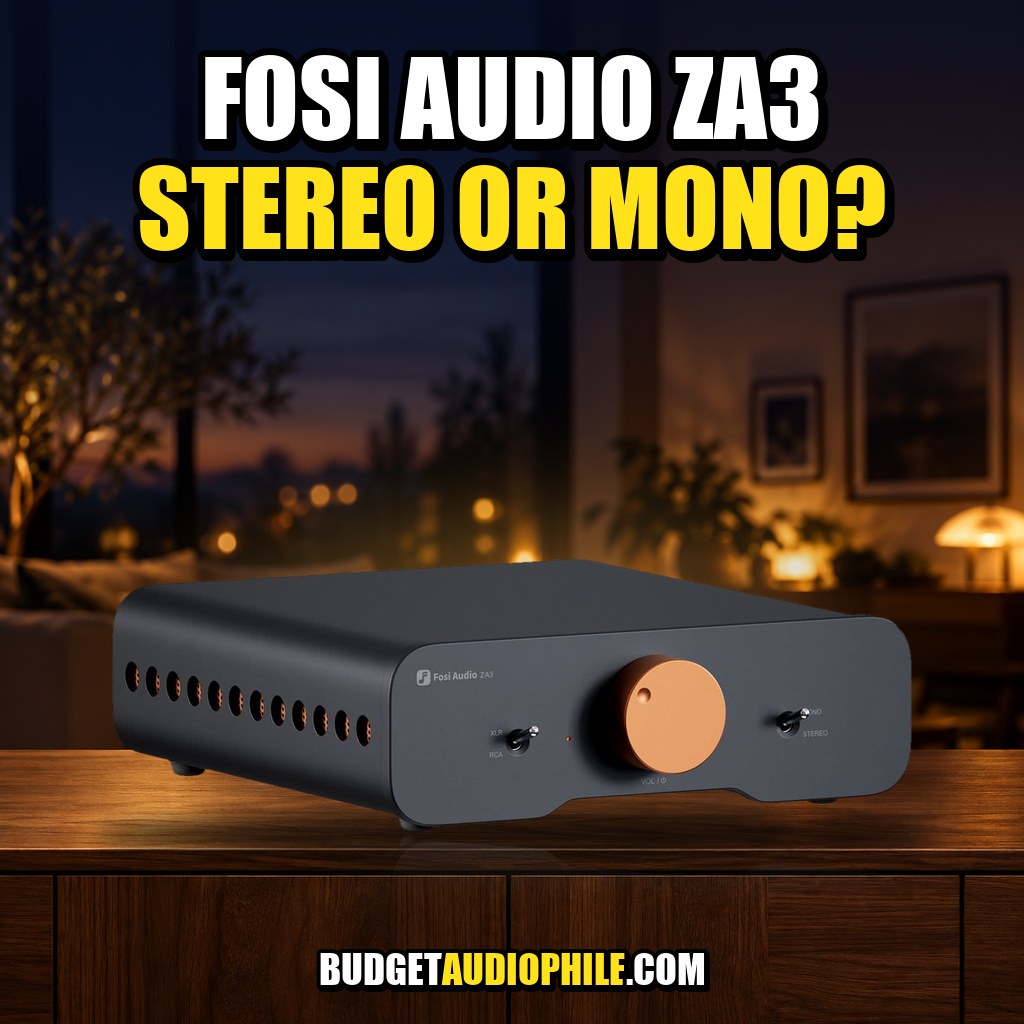
The Fosi Audio ZA3 is a compact TPA3255 Class-D power amp with balanced and RCA inputs, a subwoofer output and a front-panel stereo/mono switch, and it suits desktop and small-room systems with passive bookshelf speakers. The one thing to settle first is power: Fosi’s own page quotes three different stereo ratings, so the independent measurements are a better guide than the biggest number.
Quick answer
- Best for: 6 to 8 ohm passive bookshelf speakers on a desk or in a small room, fed by a DAC or streamer, especially with a balanced source, a subwoofer, or a second unit planned.
- Standout: XLR/TRS and RCA inputs, a filtered subwoofer output, a 12 V trigger, swappable op-amps and a mono switch for $109.99 to $149.99 (manufacturer store price, checked 2026-10-31).
- Watch out for: frequency response that shifts with speaker impedance, no PFFB (post-filter feedback), below-rating 4-ohm power in Erin’s Audio Corner’s test, and about 13 dB lower SINAD in mono mode (Audio Science Review).
- Compared to: the Fosi V3 it adds inputs, a sub output and a mono switch, but TNT-Audio heard the V3 as slightly better. The AIYIMA A20 has PFFB and a high-pass filter.
- Bottom line: a flexible, well-built budget amp that Audio Science Review measured above average. Pair it with easy 6 to 8 ohm speakers and treat the power ratings as optimistic.
Checked 2026-10-31. We did not test, measure or listen to the ZA3. This page uses Fosi’s product page (read that day), the owner feedback summarized on our ZA3 product page, and these independent sources: Audio Science Review (ASR; Amir, Feb 2024), Erin’s Audio Corner (Mar 2024), Pragmatic Audio (Dec 2023), Music For The Masses (Mar 2024), TNT-Audio (May 2024), Ear-Fidelity (Oct 2024), Soundphile Review (May 2026), Future Audiophile (updated Oct 2026) and a HiFiVision owner thread.
Fosi or its distributor supplied the unit to ASR, Music For The Masses, Soundphile Review and Ear-Fidelity; Erin’s Audio Corner bought its own. Not verified: the subwoofer filter frequency, behavior on the 32 V supply, whether current units match the 2024 samples, and whether the AIYIMA A20’s rear panel matches the ZA3’s.
Fosi Audio ZA3 specifications
| Spec | Fosi Audio ZA3 (manufacturer figures) |
|---|---|
| Amplifier chip | Texas Instruments TPA3255, Class D |
| Rated power | Stereo 180 W x 2, mono 235 W, both into 4 ohms. The description also says “up to 155W” and a comparison table says 2 x 300 W. |
| Speaker impedance | 2 to 8 ohms |
| Inputs | RCA, XLR/1/4-inch TRS combo jack, 12 V trigger; five swappable op-amp sockets |
| Outputs | Speaker terminals (banana or bare wire), active subwoofer output |
| THD / SINAD / SNR | Under 0.006% / 89 dB / 106 dB or better |
| DC input | 24 to 48 V; sold with a 32 V/5 A or 48 V/5 A supply, or without one |
| Size and weight | 6.1 x 7.2 x 2.0 in (15.49 x 18.39 x 5.08 cm), 3.9 lb (1.78 kg) |
| Warranty | 24 months |
| Store price | $109.99 without a supply, $129.99 with 32 V/5 A, $149.99 with 48 V/5 A (manufacturer store price, checked 2026-10-31) |
Source: Fosi Audio ZA3 product page, read 2026-10-31.
Read the ratings carefully: Fosi’s page shows 155 W, 180 W and 300 W for the same amp. Future Audiophile notes they appear to be 1 kHz, 10% THD ratings, and Music For The Masses points out that a 5 A supply at 32 V or 48 V tops out near 160 W or 240 W in total, so 2 x 300 W cannot be continuous output.
What the ZA3 adds over the Fosi V3
TNT-Audio sums up the ZA3 as a V3 plus a 300 Hz filtered subwoofer output, XLR and RCA inputs, a mono button and a larger cabinet. Fosi’s pages and the other reviews back most of that.
| Feature | ZA3 | V3 Mini |
|---|---|---|
| Inputs | RCA, XLR/TRS combo | RCA only |
| Extra output | Filtered subwoofer output | Pre-out with volume control |
| Mono switch | Yes, front panel | No (Fosi sells a separate V3 Mono) |
| 12 V trigger | Yes | Not listed on the page we read |
| THD / SNR | Under 0.006% / 106 dB+ | 0.003% or less / 110 dB+ |
| Size | 6.1 x 7.2 x 2.0 in | 6.5 x 4.1 x 1.4 in |
Sources: Fosi’s ZA3 and V3 pages, read 2026-10-31.
The power supply is unchanged. Both amps come with 32 V/5 A or 48 V/5 A options, and Pragmatic Audio calls the ZA3’s 48 V unit similar to the V3’s. What grew is the case, which gives more room for connections and wider spacing between the binding posts.
Subwoofer filter: the sources disagree
TNT-Audio gives 300 Hz, and Pragmatic Audio says it believes 300 Hz. A HiFiVision owner says Fosi quoted 20 to 300 Hz while other measurements show about 200 Hz. Music For The Masses states 200 Hz, and Erin’s Audio Corner measured a -3 dB point near 120 Hz. Fosi’s page lists no frequency, so treat any number as unconfirmed. Three reviewers agree that the main outputs stay full range with a sub connected, so the subwoofer’s own crossover does the blending. The V3 lists a pre-out with volume control, while the ZA3 lists only the filtered subwoofer output.
Sound and measurements
ASR placed the ZA3 above the average of the amps it has tested, almost next to the V3, and recommended it. TNT-Audio found the V3 richer in the treble in a revealing system and told V3 owners to keep theirs, while saying the two would sound the same on modest desk speakers. The reason to choose a ZA3 over a V3 is the feature list.
Stereo mode, mono mode and what the switch does
The mode switch is on the front panel, and Pragmatic Audio would rather have it at the back. Fosi calls the function PBTL, one of the TPA3255 modes Texas Instruments lists beside normal stereo. In ASR’s measurements, mono mode switches off one channel and gives the other more power, with SINAD about 13 dB lower. Fosi’s rating rises from 180 W per channel to 235 W, well short of a doubling.
For one unit in mono, a HiFiVision owner reports that the right-channel input and right speaker terminals are the live ones. We found no Fosi guidance on changing modes with the power on, so switch the amp off first.
Two units as monoblocks: each has its own volume knob, so set both to maximum and control the level from a DAC or preamp. Music For The Masses misses a true volume bypass. Two ZA3s with 48 V supplies cost $299.98 at the store prices above. Pragmatic Audio liked the separation, while TNT-Audio preferred a pair of ZeroZone monoblocks at a similar price. Our comparison of AIYIMA A20 MONO and ZA3 monoblocks covers a home-theater case, so we do not repeat it.
Power supply: 32 V or 48 V
Fosi’s store lists the ZA3 without a supply ($109.99), with 32 V/5 A ($129.99) or with 48 V/5 A ($149.99), and publishes a 24 to 48 V DC input range. In early 2024, reviewers quoted 155 W x 2 stereo and 235 W mono at 4 ohms with 48 V, and 95 W x 2 and 110 W with 32 V (Music For The Masses, Ear-Fidelity). The current Fosi page text does not split the figures by supply.
95 W against 155 W is about 2.1 dB, and doubling power adds 3 dB, so the larger supply mainly buys peak headroom. That favors 32 V for efficient speakers at desk volumes and 48 V for everything else. Some owners report a cleaner background from third-party supplies, but we found no measurement of the ZA3 on any other supply.
Pairing speakers by sensitivity
Sensitivity (dB at 1 W and 1 m) tells you how loud a speaker plays per watt, and every 3 dB needs double the power. The table is our arithmetic for 95 dB peaks at about 10 ft (3 m) from one speaker with no room gain. Treat it as an estimate.
| Speaker sensitivity | Power for 95 dB peaks at 10 ft | Example we list |
|---|---|---|
| 84 dB | About 110 W | Above the 32 V rating (95 W); use 48 V |
| 86 to 88 dB | About 45 to 70 W | Polk Signature Elite ES20 (retail listings give 86 to 88 dB) |
| 92 dB | About 18 W | Klipsch RP-500M II (92 dB per a spec database) |
Speaker figures: Rapallo AV, SpeakerDecision, HiFiVerse. Impedance matters as much. Fosi rates the ZA3 for 2 to 8 ohms, but Erin’s Audio Corner saw protection trip with two 4-ohm loads driven hard on the bench (not with real speakers), and Music For The Masses advises against 2-ohm loads in mono mode. Easy 6 to 8 ohm speakers above 86 dB leave the most margin.
Known weak points
Erin’s Audio Corner measured 4-ohm power well below the rating with both channels driven, and ASR and Erin both saw frequency response change with speaker impedance. Future Audiophile found softer dynamics at higher volumes. Ear-Fidelity confirms there is no PFFB (the V3 Mono has it) and found the ZA3 less forgiving than the SMSL AO200 MKII.
Three reviewers call the binding posts small or awkward, and Future Audiophile recommends banana plugs. There is no remote, and the power button is the volume knob, which Music For The Masses found unresponsive at times. A HiFiVision owner reports a faint pop at power on and off. Fosi’s own store summary of its customer reviews mentions delivery delays and occasional slow service replies (checked 2026-10-31). ASR’s first sample had higher gain than the revised one, so we assume, but cannot confirm, that units on sale now match the revised sample.
Fosi ZA3 vs alternatives we sell
Figures are manufacturer numbers as quoted by the sources below.
| Fosi ZA3 | AIYIMA A20 | AIYIMA A20 MONO (each) | Fosi BT20A Max | |
|---|---|---|---|---|
| Format | Stereo or mono, switchable | Stereo 2.1 | Monoblock | Stereo with Bluetooth |
| PFFB | No | Yes | Yes | Yes |
| Subwoofer features | Filtered sub out, mains full range | Sub out, adjustable high-pass | Sub out, switchable 80 Hz high-pass | Sub out, selectable high-pass |
| Published power | 180 W x 2 at 4 ohms | Up to 250 W per channel at 4 ohms | 200 W at 4 ohms (under 1% THD+N), 300 W max | 180 W x 2 RMS, 300 W x 2 max at 4 ohms |
| SNR / THD+N | 106 dB+ / under 0.006% | 116 dB+ / 0.002% | 118 dB+ / 0.002% | 112 dB+ / 0.003% or less |
| Better pick when | You want one box that can become a monoblock and PFFB is not a priority. | You run a subwoofer or want PFFB, a high-pass filter and an amp ASR has measured. | You want monoblocks from day one; Pragmatic Audio’s reviewer now prefers it to the Fosi V3 Mono. | You want Bluetooth, a remote and tone controls and do not need XLR. |
Sources: Fosi’s ZA3 and BT20A Max pages; Pragmatic Audio’s A20 and A20 MONO reviews. More amps are in our amplifier category.
Owner feedback summarized from retailer reviews
This comes from the summary on our product page, not from our own use. Owners most often praise the single-box flexibility (start in stereo, add a second unit later), the balanced plus RCA inputs and cool running. They say it handles demanding bookshelf speakers such as the Klipsch RP-500M II. Criticisms are the missing DAC and preamp, the stock supply, no tone controls or EQ, and a mono improvement that some owners call subtle.
Affiliate disclosure: the buttons above are affiliate links, and we may earn a commission at no extra cost to you. Store prices on this page were read from Fosi’s site on 2026-10-31 and can change.
Update log: 2026-10-31, first version. Specs and store prices read from Fosi’s ZA3, V3 and BT20A Max pages that day; reviews listed above re-read for dates and figures.