

The Micca MB42X G2 is the best budget bookshelf speaker among the pairs we sell, the Polk Signature Elite ES20 is the pick when bass matters, and the Sony SS-CS5M2 fits a living room built around a receiver. All seven picks are passive, so each needs a separate amplifier, and sensitivity, impedance and recommended power decide whether a pair suits the amp you own.
Quick answer
- Best for: a first pair or a desk, the Micca MB42X G2; bass, the Polk ES20; a receiver, the Sony SS-CS5M2.
- Standout: Audio Science Review measured the Polk ES20 6 dB down at about 45 Hz and the Micca G2 at about 59 Hz.
- Watch out for: Klipsch rates the RP-500M II at 92 dB, and Erin’s Audio Corner estimates about 85 dB anechoic.
- Compared to: active desk speakers such as the HiVi-Swans OS-10 have the amplifier built in, while passive pairs need their own and let you upgrade it later.
- Bottom line: pick the job first and match the amplifier second. We found no independent measurements for the Oasis 140 or the D3.1 MkII.
Checked 2026-10-31. Specs come from the Polk, Klipsch and Fosi pages, Amazon listings that carry the brand’s own spec text (Micca, HiVi-Swans, Sony) and an EU distributor page (Oasis 140 power). Measurements come from Audio Science Review, Erin’s Audio Corner, Archimago and Pragmatic Audio. Owner feedback summarizes retailer reviews on our product pages. We did not listen to or test any pair.
Not verified: Sony’s M2 sensitivity, the Oasis 140’s sensitivity, and independent measurements of the Oasis 140 and D3.1 MkII. Prices are omitted except two manufacturer-store prices read on the check date.
Specs side by side
| Speaker | Woofer / tweeter | Sensitivity as published | Power guidance | Impedance | Size, H x W x D |
|---|---|---|---|---|---|
| Micca MB42X G2 (best under about $150) | 4 in carbon fiber / 0.75 in silk dome | 86 dB (1 W, 1 m) | 80 W per speaker (handling) | 4 to 8 ohm | 9.5 x 5.8 x 6.5 in (24 x 15 x 17 cm) |
| HiVi-Swans Oasis 140 (second desk option) | 4 in metal / 20 mm soft dome | not published | 25 W RMS, 50 W max | 4 ohm | 9.25 x 7.8 x 5.9 in (23.5 x 19.8 x 15 cm) |
| Sony SS-CS5M2 (all-rounder for a receiver) | 5.12 in cellular cone / 0.98 in dome plus super-tweeter | no official figure found | 100 W max input | 6 ohm | 13.2 x 7 x 8.7 in (33.5 x 17.8 x 22.1 cm) |
| Polk Signature Elite ES20 (best bass) | 6.5 in polypropylene / 1 in Terylene dome | 86 dB (2.83 V, 1 m) | 20 to 125 W recommended | 4 and 8 ohm outputs | 14.8 x 8.5 x 13.8 in (37.6 x 21.6 x 35.1 cm) |
| Klipsch RP-500M II (dynamics at moderate volume) | 5.25 in Cerametallic / 1 in titanium on a horn | 92 dB (2.83 V, 1 m, rated in-room) | 75 W continuous, 300 W peak | 8 ohm compatible | 13.56 x 6.81 x 10.65 in (34.4 x 17.3 x 27 cm) |
| HiVi-Swans D3.1 MkII (step-up with a strong amp) | 6.5 in / 28 mm dome | 85 dB (2.83 V, 1 m) | 10 to 120 W | 8 ohm | 14.88 x 8.58 x 14.17 in (37.8 x 21.8 x 36 cm) |
| Fosi Audio SP601 (best looks, with caveats) | 6.5 in HybridCone / 1.5 in silk dome | 86 dB | 80 W RMS, 160 W peak | 4 ohm | not on the store page |
Sources: the Polk ES20 page, the Klipsch spec sheet, the Fosi SP601 page, an EU distributor listing for the Oasis 140, and the brand text on the Amazon listings below.
The seven picks, with one reason to skip each
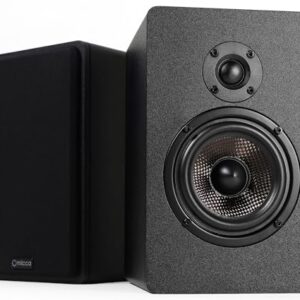
1. Micca MB42X G2: best under about $150
Micca lists a 4-inch carbon-fiber woofer, a 0.75-inch silk dome, 55 Hz to 20 kHz, 86 dB (1 W, 1 m), 4 to 8 ohms and 80 W per speaker. It was the lowest-priced of the seven on the listings we read on 2026-10-31. Audio Science Review measured it 6 dB down at about 59 Hz, with a 300 Hz to 3 kHz average of 82.7 dB, below the 86 dB rating. Micca’s RB42, a different model, has its own review here.
Skip it if you want bass below about 60 Hz without a subwoofer.
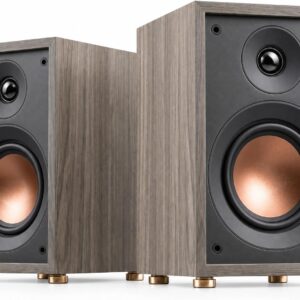
2. HiVi-Swans Oasis 140: second desk option
The brand lists a 4-inch metal woofer and a 20 mm soft dome and calls the Oasis 140 the successor to the OS-10, which is active; the Oasis is passive. An EU distributor lists 25 W RMS, 50 W maximum and 4 ohms. No listing states a sensitivity and we found no independent measurement, so it is the least documented pair here.
Skip it if you want measured data, or plan to drive it with a high-power amplifier.
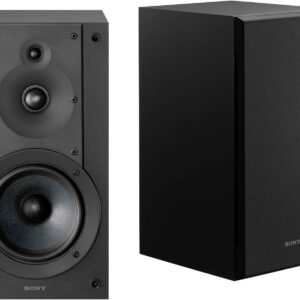
3. Sony SS-CS5M2: best all-rounder under $300 for a receiver
A three-way design with a 5.12-inch woofer, a 0.98-inch tweeter and a super-tweeter, rated 6 ohms, a lighter load than the 4-ohm Oasis 140 and SP601. Archimago measured the bass 6 dB down near 60 Hz, a softer top end than the earlier SS-CS5M1 and a minimum impedance of 5.6 to 5.7 ohms. He found no official M2 sensitivity and puts it near 88 dB, based on the 87 dB Sony gives the earlier model, and suggests an 80 Hz subwoofer crossover. Our budget system guide covers a WiiM Amp plus Sony SS-CS5 build.
Skip it if you want low bass without a subwoofer, or you sit well below the tweeters.
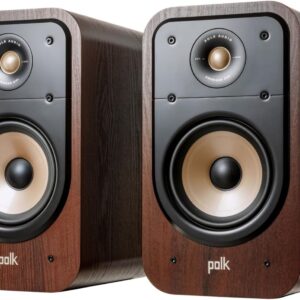
4. Polk Signature Elite ES20: best bass from a bookshelf pair
Polk lists a 6.5-inch woofer, a 1-inch Terylene dome, 41 Hz to 40 kHz, 86 dB (2.83 V, 1 m), a recommended 20 to 125 W and 4-ohm and 8-ohm outputs. Manufacturer store price, checked 2026-10-31: $399 per pair at Polk, in stock. Audio Science Review measured it 6 dB down at about 45 Hz, with a 300 Hz to 3 kHz average of 87.5 dB and a 3.5 dB deviation over 300 Hz to 5 kHz, against 2.8 dB for the Micca.
Skip it if your shelf is shallower than 13.8 in (35 cm).
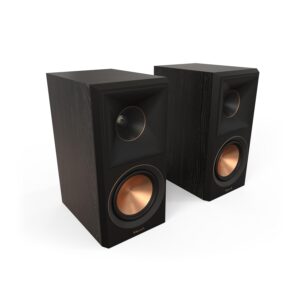
5. Klipsch RP-500M II: best for dynamics at moderate volume
The spec sheet lists a 5.25-inch Cerametallic woofer, a 1-inch titanium tweeter on a Tractrix horn, 50 Hz to 25 kHz (plus or minus 3 dB), 75 W continuous, 8 ohms and a rear port. Erin’s Audio Corner estimates about 85 dB anechoic against the 92 dB rating and found a 10 to 15 kHz treble peak that can strain synth music and hi-hats. He prefers the pair toed out, so you sit about 30 degrees off axis.
Skip it if bright treble bothers you, or you listen loudly in a big room.
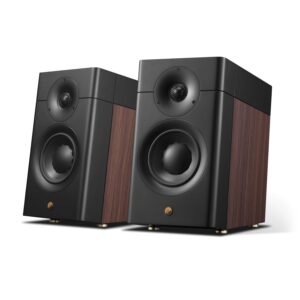
6. HiVi-Swans D3.1 MkII: best step-up with a strong amplifier
The brand text on the Amazon listing gives a 6.5-inch woofer, a 28 mm dome, 85 dB (2.83 V, 1 m), 8 ohms, 10 to 120 W and 39 Hz to 20 kHz, with a tilted baffle. The 39 Hz figure is a manufacturer claim with no independent confirmation. It was the highest-priced of the seven on the listings we read.
Skip it if your amplifier is small, since owner reviews on our product page say it does better with more power.
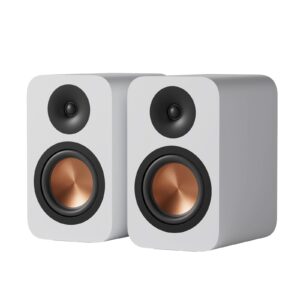
7. Fosi Audio SP601: best looks, with caveats
Fosi lists a 6.5-inch HybridCone woofer, a 1.5-inch silk dome, 86 dB, 4 ohms and 80 W RMS. Manufacturer store price, checked 2026-10-31: $399.99 per pair at Fosi, in stock. Erin’s Audio Corner measured a scooped midrange, a 4 to 6 kHz boost and in-room bass rolling off near 70 Hz, and judged that better speakers exist at the price. Pragmatic Audio gave it 4 out of 5 at retail and 5 out of 5 with EQ, and saw the same peak near 5 kHz.
Skip it if you want a neutral balance without EQ.
How to match bookshelf speakers to an amplifier
Passive or active
A passive speaker has no amplifier inside; the Oasis 140 and D3.1 MkII listings warn against connecting it to a phone or computer. An active speaker such as the HiVi-Swans OS-10 (62 W RMS, Bluetooth 5.0, per its listing) carries its own. Choose passive if you own a receiver or want to upgrade the amp later, and active for a desk with no extra box. Our speakers category lists both.
Sensitivity, power and impedance
Sensitivity says how loud a speaker plays per watt. Each extra 3 dB halves the amplifier power needed, per HiFiReport, and ELAC treats speakers above 90 dB as easy to drive and those below 87 dB as needing more power. The published figures here are 85 or 86 dB for the Micca, Polk, D3.1 MkII and Fosi pairs and 92 dB for the Klipsch. Methods differ, though: a 2.83 V rating flatters a 4-ohm speaker by roughly 3 dB, per HiFiReport, and measurements can disagree with ratings, as the Klipsch and Micca picks show.
For power, ELAC advises matching the amplifier’s continuous rating to the speaker’s, ignoring peak figures, and calls underpowering and clipping the bigger risk. Impedance matters too: amplifier ratings are quoted at a stated load, and lower-impedance speakers draw more current, as SoundStage Access notes.
Room, distance and stands
Klipsch’s manual suggests 6 to 15 ft (1.8 to 4.6 m) between speakers, seating about 1 to 1.5 times that spacing away, and slight toe-in. Keep tweeters near ear height: Archimago saw the Sony’s vertical response turn choppy around 30 degrees, and Pragmatic Audio found that stands improved the SP601’s imaging and that 8 to 12 in (20 to 30 cm) from the wall gave the best balance. Woofer size sets the bass floor: the 4-inch Micca G2 measured 6 dB down at about 59 Hz, the 6.5-inch Polk ES20 at about 45 Hz. Room size and volume matter too: Erin’s Audio Corner rates the RP-500M II for moderate volumes at longer distances and suggests the RP-600M II for higher output.
Versions that get confused
- Micca MB42X and G2: Micca calls the G2 the upgraded successor. Listings show 55 Hz, 86 dB, a 12 dB/octave crossover and 80 W for the G2, against 60 Hz, 85 dB, 18 dB/octave and 75 W for the original, which we also sell. The measurements here are for the G2.
Amplifiers from our catalog that fit these pairs
| Amplifier | Rated power (maker) | Works with | Good to know |
|---|---|---|---|
| Fosi Audio ZA3 | 180 W x 2 at 4 ohm; 2 to 8 ohm loads | Polk ES20, Klipsch RP-500M II, D3.1 MkII, SP601 | XLR, RCA and TRS inputs; subwoofer output; no tone controls |
| Fosi Audio BT20A MAX | 180 W RMS x 2 at 4 ohm; 2 to 8 ohm loads | the same pairs, streaming from a phone | Bluetooth with LDAC and aptX; subwoofer output |
| WiiM Amp | 60 W per channel at 8 ohm, 120 W at 4 ohm | Micca G2, Sony SS-CS5M2, Oasis 140 | HDMI ARC and optical inputs; subwoofer output |
Power figures are the makers’ ratings (ZA3, BT20A MAX, WiiM). The Oasis 140’s 50 W maximum is well below what the Fosi amplifiers deliver into 4 ohms, so keep the volume sensible. More options are in the amplifiers category.
Owner feedback summarized from retailer reviews
This is our summary of retailer reviews already on three product pages, not a listening test, and we have not verified the reviews. Polk ES20 owners warn most about cabinet depth and split on the walnut finish. Klipsch RP-500M II owners praise detail and dynamics but note a bright character with bright amplifiers and a need for space behind the rear port. D3.1 MkII owners say it needs a strong amplifier; the heavy speakers arrive in thin packaging, so inspect the box.
Disclosure: some links on this page are affiliate links. We may earn a commission at no extra cost to you, and as an Amazon Associate we earn from qualifying purchases. Prices are not shown because they change.
Update log
2026-10-31: first version. Specs, stock and measurements checked.