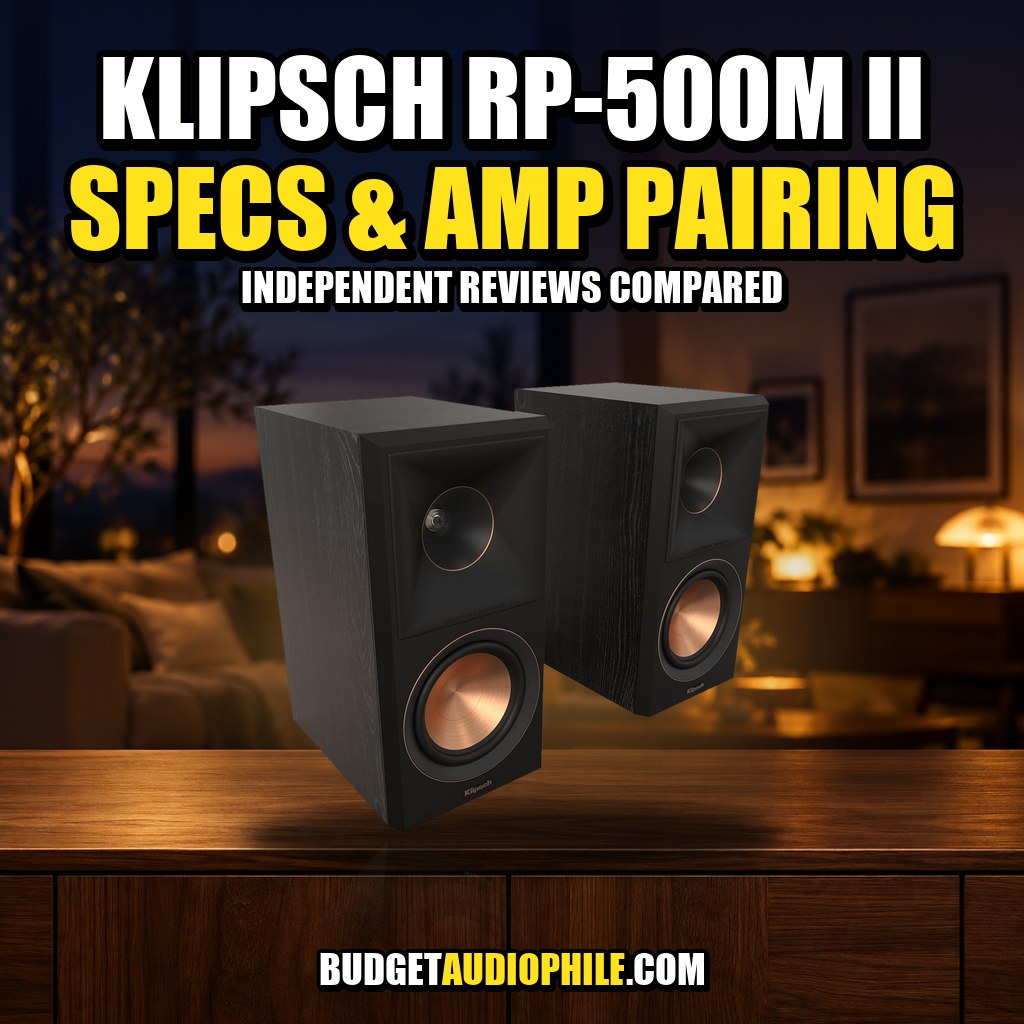
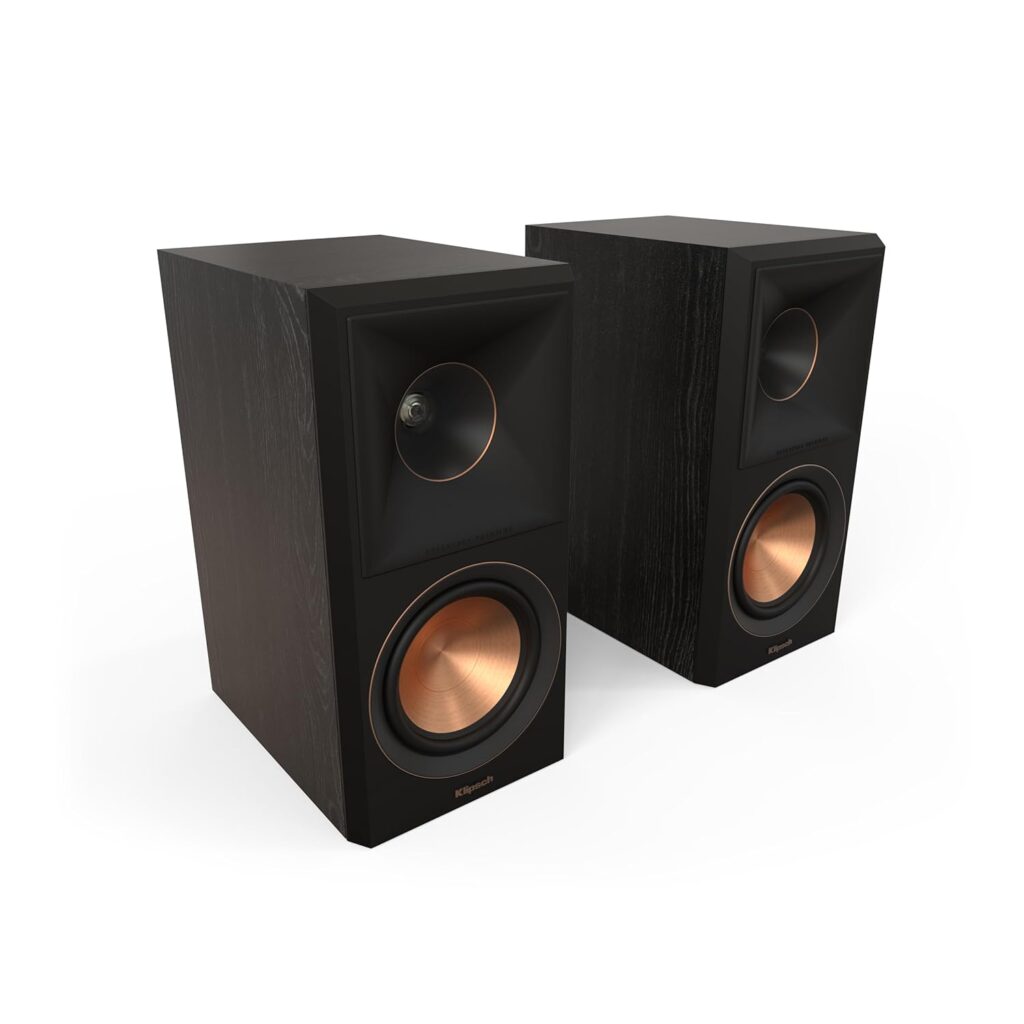
The Klipsch RP-500M II is a compact two-way bookshelf speaker with a 90° × 90° Tractrix horn and a 1-inch titanium tweeter, made for listeners who want lively, forward sound and are willing to add a subwoofer. The one number to question is Klipsch’s 92 dB sensitivity: Erin’s Audio Corner measured about 85 dB, so choose an amplifier for a speaker of ordinary efficiency.
Quick verdict
- Best for: lively stereo or front-channel duty in a small to mid-size room, ideally with a subwoofer.
- Standout: a larger horn and a cleaner midrange than the first RP-500M, about 5 dB more output between 1 and 3 kHz in Erin’s Audio Corner measurements.
- Watch out for: measured sensitivity near 85 dB against the 92 dB claim, a treble peak around 10 to 15 kHz, and bass that is 3 dB down near 69 Hz.
- Compared to: the RP-600M II plays louder and lower but measured brighter. The Polk ES20 measured deeper bass and slightly higher sensitivity, with a dome tweeter.
- Bottom line: a good horn speaker if you want energy. Add a subwoofer, pick a smooth-sounding amplifier and try the toe-out placement; look elsewhere for a warm, relaxed sound.
Checked 2026-10-31. We did not listen to, measure or test this speaker. The page draws on Klipsch’s own pages and spec sheets, Erin’s Audio Corner’s Klippel measurements and video (June 2022), spinorama.org, Speaker Ranking, Stereophile’s and StereoNET’s reviews of the larger RP-600M II, manufacturer pages for the alternatives, and the owner feedback summarized on our RP-500M II product page.
Not verified: each independent number comes from one lab, so treat gaps of a decibel or two as noise. Sensitivity and bass-point figures are spinorama.org’s calculations from Erin’s data. We read no forum threads and found no independent measurements of the HiVi-Swans D3.1 MKII. Sources are linked where used.
Klipsch RP-500M II specifications
| Spec | Klipsch figure |
|---|---|
| Tweeter | 1-inch titanium Linear Travel Suspension (LTS), vented housing |
| Horn | 90° × 90° silicone composite hybrid Tractrix horn with phase plug |
| Woofer | 5.25-inch Cerametallic cone with Faraday rings |
| Crossover | 1530 Hz |
| Frequency response | 50 Hz to 25 kHz, ±3 dB |
| Sensitivity | 92 dB at 2.83 V / 1 m (described by Klipsch as an in-room figure) |
| Power handling | 75 W continuous / 300 W peak |
| Impedance | 8 ohms compatible |
| Enclosure | Internally braced MDF, bass reflex, rear-firing Tractrix port |
| Inputs | Single aluminum binding posts |
| Size | 13.56 in H × 6.81 in W × 10.65 in D (34.4 × 17.3 × 27.0 cm) |
| Weight | 13.1 lb (5.95 kg) each |
Source: Klipsch RP-500M II spec sheet (v02) and the Klipsch product page. Per-speaker weight as listed by Erin’s Audio Corner.
RP-500M II vs the first RP-500M and the R-51M
Klipsch lists these changes on the II: a new, larger horn, a redesigned Cerametallic woofer, extra cabinet bracing, a new input panel and cork pads instead of rubber bumpers. The spec sheet adds that the larger horn is meant to give a bigger soundstage and better directivity.
| Klipsch figure | RP-500M (first) | RP-500M II | R-51M |
|---|---|---|---|
| Woofer | 5.25-inch Cerametallic | 5.25-inch Cerametallic with Faraday rings | 5.25-inch spun-copper IMG |
| Tweeter | 1-inch titanium LTS, vented | 1-inch titanium LTS, vented, larger horn | 1-inch aluminum LTS |
| Response, ±3 dB | 48 Hz to 25 kHz | 50 Hz to 25 kHz | 62 Hz to 21 kHz |
| Sensitivity | 93 dB | 92 dB | 93 dB |
| Crossover | 1500 Hz | 1530 Hz | 1660 Hz |
| Power, cont. / peak | 75 W / 300 W | 75 W / 300 W | 85 W / 340 W |
| Size, H × W × D | 13.50 × 6.81 × 9.50 in | 13.56 × 6.81 × 10.65 in | 13.3 × 7 × 8.5 in |
| Finish | Ebony, Walnut, Piano Black | Ebony, Walnut | Black textured vinyl |
Sources: Klipsch spec sheets for the RP-500M, RP-500M II and R-51M.
The change that matters in use is the midrange. Erin’s Audio Corner compared the two and found about 5 dB more output between 1 and 3 kHz on the II, with the rest of the curve close. He said he would rather own the II. In his video he adds that the distortion plots look a little less clean in the tweeter region, which he puts down to crossover placement and does not treat as a dealbreaker (review, video).
The R-51M that turns up in the same searches is a different speaker. Klipsch’s R-51M page places it in the Reference Series and points visitors to a newer Reference line. If you are buying used, Klipsch lists Piano Black only for the first RP-500M, and the II is about 1.2 inches deeper (10.65 against 9.50 inches).
How loud and how deep: sensitivity, amplifier power and bass
Klipsch’s sheet gives 92 dB at 2.83 V and 1 m, footnoted as an in-room sensitivity figure. Erin’s Audio Corner says Klipsch rates its speakers in an unorthodox way and that, measured anechoically, the RP-500M II is closer to 85 dB; spinorama.org lists 85.2 dB. Erin notes that most bookshelf speakers this size land between 84 and 87 dB. The gap is not unique to this model. Erin’s data gives 86.0 dB for the RP-600M II against Klipsch’s 94.5 dB, and Stereophile’s John Atkinson estimated the original RP-600M at 89.6 dB(B) against a 96 dB spec.
| RP-500M II | Klipsch figure | Erin’s Audio Corner data |
|---|---|---|
| Sensitivity | 92 dB | 85.2 dB |
| Bass | 50 Hz, ±3 dB | 3 dB down at 68.8 Hz, 6 dB down at 60.1 Hz |
| Maximum output | not stated | about 95 dB at 4 m (13 ft) for the pair before the woofers began to unload |
Sensitivity and bass points from spinorama.org’s page for Erin’s data (relative to the midrange level); output limit from Erin’s video.
None of this makes the speaker hard to drive. The Klipsch manual calls its speakers 8-ohm compatible and says they can be driven to very high levels with low distortion. Speaker Ranking, citing Erin’s data, reports a minimum impedance of 3.3 ohms; we could not confirm that on Erin’s page, which shows impedance only as a graph.
Erin calls the speaker better suited to moderate volumes at longer listening distances, especially without a subwoofer, and says a subwoofer with a suitable crossover removes the woofer-unloading problem. He would buy the RP-500M II plus a capable subwoofer rather than step up to the RP-600M II.
Is the treble bright? What the measurements and reviewers say
Erin’s Audio Corner measured a lifted treble but wrote that it “isn’t enough to make you take immediate notice” (review). He also found a peak around 10 to 15 kHz that can make synth music sound quite strained and can bother on hi-hats. About 30 degrees off axis the highs tilt down, which he finds more enjoyable.
That produces opposite placement advice. Klipsch’s manual suggests placing the pair 6 to 15 feet (1.8 to 4.6 m) apart, with the listening position 1 to 1.5 times that distance away, and toeing them in slightly for better imaging. Erin recommends toeing them out so the listening seat sits off axis, with two cautions: a lively room adds reflections, and imaging precision drops a little. Try the manual’s slight toe-in first, then aim the pair past your ears and keep whichever sounds better.
Erin measured the RP-600M II about 2 to 3 dB higher in the highs and calls the RP-500M II the more neutral of the two. Two reviews of the larger speaker give context, since both use a 90° × 90° hybrid Tractrix horn. StereoNET called the RP-600M II explicitly voiced and a “Marmite” loudspeaker. Stereophile found its enlarged horn smoother and more refined than the original’s and preferred it with the grilles off (review). Those are RP-600M II impressions, not RP-500M II ones.
Watch Erin’s Audio Corner video on the RP-500M II
Which amplifier to pair with the RP-500M II
Klipsch publishes no list of recommended amplifiers. Its numbers (75 W continuous, 8-ohm compatible) fit most stereo amplifiers and receivers, and the measured sensitivity argues for a competent amplifier with some headroom. Two Class-D amplifiers we sell fit on paper:
- Fosi Audio ZA3 uses a TI TPA3255 chip with RCA, XLR and 1/4-inch TRS inputs. Fosi’s page lists 2 to 8 ohm loads and 180 W per channel at 4 ohms in its spec line (its description says up to 155 W).
- Fosi Audio BT20A Max is rated at 180 W RMS per channel at 4 ohms, takes two RCA inputs plus Bluetooth, and has a subwoofer output and a selectable high-pass mode, which suits the subwoofer advice above. Fosi’s page lists 2 to 8 ohm loads.
Owner reports on our product page also name the AIYIMA A80, 3e Audio A7, Yamaha A-S series, vintage Marantz receivers and tube integrated amplifiers, and say a warmer amplifier calms the top end. We have not verified those pairings. Low-power tube amplifiers can work in a small room at moderate volume: Stereophile ran the RP-600M II from a 3.5 W tube amplifier and reported lively dynamics, and Erin’s data puts that speaker within 1 dB of the RP-500M II. Expect limited headroom. More options are in our amplifier category.
RP-500M II vs RP-600M II, Polk ES20 and other alternatives we sell
| Speaker | Drivers | Sensitivity: claim / measured | Bass, measured: 3 dB / 6 dB down | Pick it instead when |
|---|---|---|---|---|
| Klipsch RP-500M II (this page) | 5.25-inch woofer, 1-inch titanium tweeter on a horn | 92 dB / 85.2 dB | 68.8 Hz / 60.1 Hz | You want horn energy in a compact cabinet and will add a subwoofer. |
| Klipsch RP-600M II | 6.5-inch woofer, same style of horn tweeter | 94.5 dB / 86.0 dB | 74.7 Hz / 54.2 Hz | The room is larger or you want more headroom, and accept a brighter top end and a cabinet about 2 inches taller. |
| Polk Signature Elite ES20 | 6.5-inch polypropylene woofer, 1-inch Terylene dome tweeter | 86 dB / 87.5 dB | 55.7 Hz / 45.4 Hz | You want more bass and a dome tweeter, and have room for a bigger cabinet (14.8 × 8.5 × 13.8 inches). |
| HiVi-Swans D3.1 MKII | 6.5-inch woofer, dome tweeter of about 1 inch (retailer listing) | No maker figure found / none | No measurement found | You prefer a dome tweeter with a 6.5-inch woofer and accept the lack of independent measurements. |
| Micca MB42X G2 | 4-inch carbon-fiber woofer, 0.75-inch silk dome | 86 dB / 82.7 dB | 68.8 Hz / 58.6 Hz | The room is small or the budget is tight; its bass roll-off measured similar to the Klipsch. |
Claims from Klipsch spec sheets (RP-500M II, RP-600M II), the Polk information sheet, and the maker figure shown on spinorama.org’s Micca page. Measurements via spinorama.org: Erin’s Audio Corner for the RP-500M II and RP-600M II; Audio Science Review for the Polk ES20 and Micca MB42X G2. Sensitivity is the 300 Hz to 3 kHz average at 2.83 V; the labs differ. HiVi details come from a retailer listing and Micca driver sizes from a retailer listing, as no maker spec sheets turned up.
The numbers show a reversal. Klipsch’s claimed 6 dB lead over the Polk (92 dB against 86 dB) becomes a measured deficit of about 2 dB (85.2 against 87.5 dB), although different people did the measuring.
Owner feedback summarized from retailer reviews
Our RP-500M II product page carries a summary of Amazon owner reviews as of August 2026. It covers five-star reviews, so it leans positive, and it gives themes without counts. Paraphrased:
What owners report
- Praise: dynamic, clear highs; strong results on modest amplifiers; a furniture-style finish; a good fit as front speakers in a home theater.
- Criticism: the sound turns bright with harsh amplifiers or poor recordings and can tire some listeners; the rear port needs space from the wall; stands matter; it is not a warm, neutral speaker; and buyers should confirm they get the II, not the first RP-500M.
Owners often call the bass punchy for the size. The measurements show a roll-off below roughly 60 to 70 Hz, and both can be true, because punch and depth are different things.
The button opens the RP-500M II listing on Amazon. Confirm the finish, seller and return terms there. Some links on this page are affiliate links, and we may earn a commission from qualifying purchases at no extra cost to you. Prices are set by the retailer, so none are shown here.
Klipsch RP-500M II FAQ
Are the Klipsch RP-500M II good speakers?
How much amplifier power does the RP-500M II need?
Is the RP-500M II really 92 dB sensitive?
Are the Klipsch RP-500M II too bright?
Do the RP-500M II need a subwoofer?
What is the difference between the RP-500M II and the original RP-500M?
Should I buy the RP-500M II or the RP-600M II?
RP-500M II vs Polk ES20: which is better?
Can the RP-500M II be bi-wired?
Is the Klipsch R-51M the same as the RP-500M II?
Is the Klipsch warranty valid if I buy the RP-500M II on Amazon?
Update log. 2026-10-31: first version; all sources retrieved the same day.