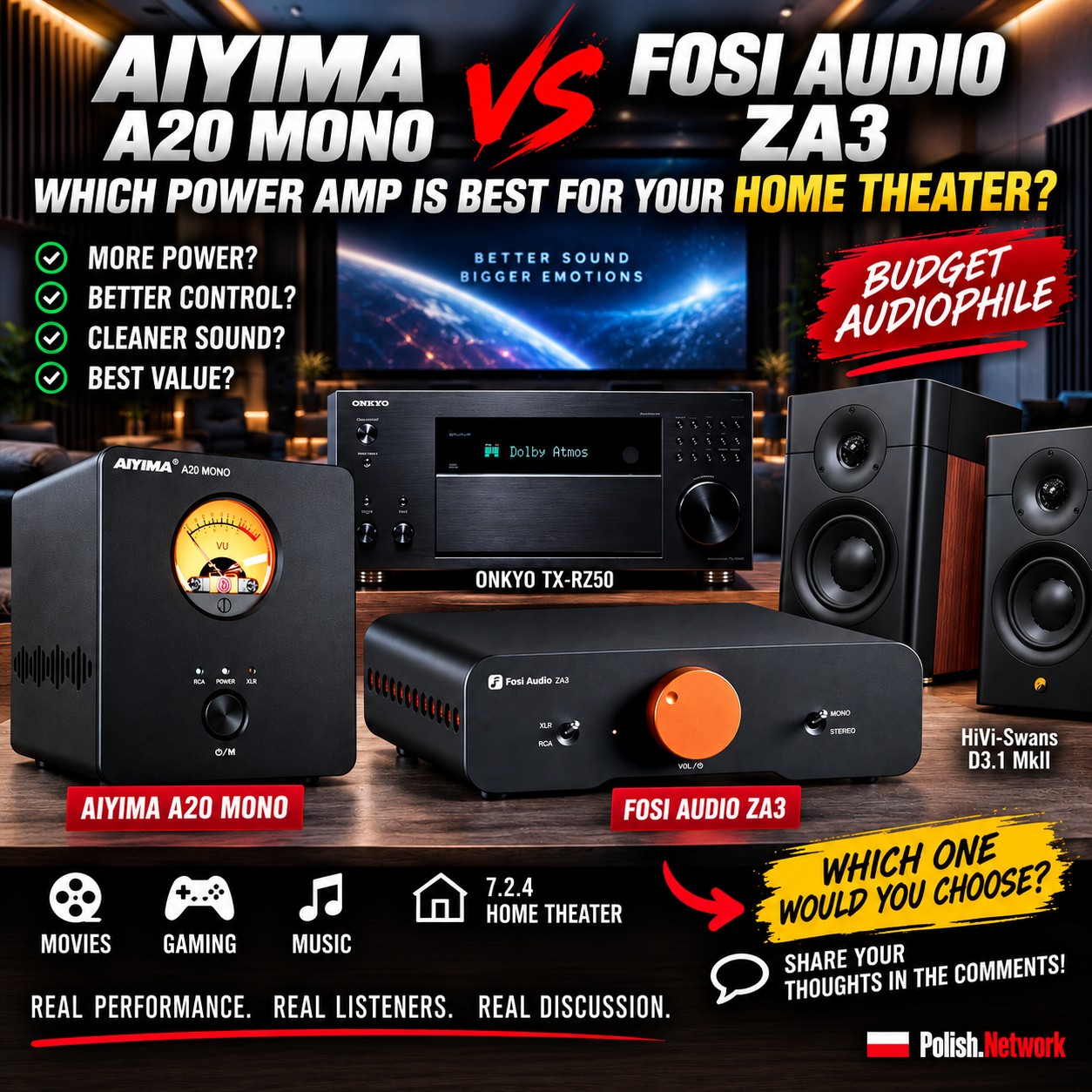
Three configurations compete for the same job: a pair of AIYIMA A20 MONO monoblocks, a single Fosi Audio ZA3 in stereo mode, or two Fosi Audio ZA3 units bridged as monoblocks (PBTL). All three use the same Texas Instruments TPA3255 chipset, but they differ in topology, feedback architecture, gain structure, and integration behavior with the Onkyo’s Dirac Live calibration. This is the pure engineering breakdown — no marketing, no vibes.
System environment — the current-hungry problem
Before we compare amplifiers, we need to acknowledge what they’re driving and what’s feeding them.
The speaker load: HiVi-Swans D3.1 MkII
The HiVi-Swans D3.1 MkII is a demanding load in this context. Nominal impedance is 8 ohms with dips into the mid-4-ohm range in the bass region, but the real challenge is sensitivity: ~85 dB (1W/1m). That is below the class average and means the speaker needs meaningful current headroom and clean voltage swing to hit reference cinema levels (75-90 dB SPL sustained at the listening position, ~105 dB peaks) without clipping the amplifier. For deep-dive listening data, see our full HiVi-Swans D3.1 MkII review with 15-track A/B protocol.
The processor: Onkyo TX-RZ50
The Onkyo TX-RZ50 is doing double duty. Internally it processes up to 11.2 channels (7 base + 4 height + 2 subs), but only 9 channels of amplification are built in. To run a full 7.2.4 configuration (7 base + 2 subs + 4 height / ceiling), you must add external amplification for at least two channels — typically the front L/R pair via the receiver’s Pre-Out RCA outputs. This is the exact scenario where budget class-D external amps earn their keep: high sensitivity, no shared internal amp channels stealing PSU headroom from the front stage, and Dirac Live doing the room correction downstream of the amp.
Why external front-channel amplification matters here
The front L/R pair is doing the heaviest lifting in any Atmos or DTS:X mix. Every dialog line, every score cue, every hard bass hit in the front stage — the whole cinematic experience — runs through those two channels. If they clip, the illusion collapses. Offloading them to a dedicated external amp both frees the Onkyo’s internal amp stage to breathe (reducing thermal load on the AVR) and gives the D3.1 MkII the current headroom their 85 dB sensitivity demands.
Detailed engineering comparison table
All three configurations use the Texas Instruments TPA3255 class-D chipset. The differences are in topology, power supply architecture, feedback design (PFFB vs no PFFB), and user-controllable gain stages. Both Fosi ZA3 configurations assume an optimal 48V/5A power supply per unit; both A20 MONO monoblocks are shown with their bundled or upgraded 48V PSU.
| Parameter | AIYIMA A20 MONO (2× monoblocks — true dual mono) |
Fosi ZA3 Stereo mode (1 unit) |
Fosi ZA3 PBTL Mono mode (2 units) |
|---|---|---|---|
| Physical topology | Two physically separate monoblocks, dedicated PSU per channel | Single stereo chassis, shared PSU | Two chassis in PBTL bridged mono, dedicated PSU per amp |
| Chipset | TPA3255 + PFFB | TPA3255 (no PFFB in PBTL) | TPA3255 (no PFFB in PBTL) |
| RMS power (8 Ω, THD < 1%) | ~100 W per channel | ~50-60 W per channel (shared PSU) | ~110-120 W per channel |
| RMS power (4 Ω, THD < 1%) | ~200 W per channel | ~155 W per channel | ~235 W per channel |
| PFFB (Post-Filter Feedback) | Yes — feedback loop after the output LC filter | Not in PBTL topology | Not in PBTL topology |
| THD dependency on speaker load | Load-independent (flat THD across speaker impedance curve) | Load-dependent | Load-dependent |
| SNR | ≥ 118 dB | ≥ 106 dB | ≥ 106 dB |
| THD+N | 0.002% | < 0.006% | < 0.006% |
| Analog inputs | Balanced XLR + RCA + 6.35mm TRS | XLR + RCA + TRS | XLR + RCA + TRS (one input per unit) |
| Gain adjustment | Physical switch (19 dB / 25 dB) | Fixed factory 29 dB (no user control) | Fixed factory 29 dB (no user control) |
| Volume potentiometer | None — pure power amp, Onkyo drives level | Yes — must be set to max as power amp | Yes — two units, requires exact-match knob alignment on both |
| 12V trigger input | Yes (mini-jack) | Yes (mini-jack) | Yes, but requires Y-splitter for two units |
| High-pass filter | Yes — 80 Hz hardware switch (offloads bass to subs) | No (full range only) | No (full range only) |
| Thermal architecture | Larger chassis, excellent convection cooling | Smaller chassis, heats up more | Two units share thermal load — less heat per box |
Configuration analysis — how each performs in this exact system
1. AIYIMA A20 MONO pair (dual-mono, separate chassis)
Current headroom & PSU behavior. Two dedicated 48V PSUs deliver stable rail voltage even when the demanding HiVi-Swans (85 dB sensitivity) draw peak current on cinema explosions. ~100 W into 8 ohms per channel is comfortably above what these speakers need for reference-level 5.1 or 7.1 fronts in a typical 12×15 to 15×17 ft home theater room.
PFFB (Post-Filter Feedback) — the decisive engineering advantage. The A20 MONO’s PFFB loop closes the feedback after the output LC filter. This means the amp compensates for the interaction between its own output filter and the speaker’s non-linear impedance curve. Practical result: frequency response stays flat regardless of the HiVi-Swans’ impedance dips, and the top-end doesn’t develop the pinched, sibilant edge that non-PFFB class-D amps can produce with reactive speaker loads. On dialog-heavy material this shows up as smoother sibilants; on treble-forward score cues it shows up as less listener fatigue over a 2-hour movie.
No volume potentiometer — the sleeper win for Dirac Live. The A20 MONO has no user volume control. It’s a pure power amp. Onkyo TX-RZ50 sets the level via its master volume and Dirac Live handles per-channel trim. This means you cannot accidentally miscalibrate the front stage by nudging an amp knob. In a system with wife/kids/cleaners moving around your rack, this is a real reliability feature.
Hardware 80 Hz high-pass filter. If you want to relieve the D3.1 MkII of below-80 Hz duty and let both subs handle everything below the crossover (standard THX-style bass management), the A20 MONO does it with one hardware switch. This is cleaner than relying on the Onkyo’s speaker crossover setting for the same job because it happens at the amp, before power stage current is spent on frequencies you’re crossing over anyway.
12V trigger integration. Both monoblocks accept the Onkyo’s 12V trigger output via mini-jack — the amps power on with the receiver automatically, no manual sequencing. Two amps, one trigger daisy-chain, no fuss.
Trade-off. Two-chassis footprint, two power outlets, higher street price than a single ZA3. You’re paying for topology, not chipset.
2. Fosi ZA3 stereo mode (single unit)
Current headroom & PSU behavior. Weakest of the three configurations for this specific job. A single 48V/5A PSU has to feed both channels simultaneously. On the HiVi-Swans’ 85 dB sensitivity, cinema-level explosions and complex movie soundtracks compete for the same PSU rail current. The result: reduced headroom, faster clipping under sustained loud passages, and audibly compressed dynamics at reference cinema volume.
PFFB behavior in stereo. The ZA3 does implement PFFB in stereo mode (it’s a marketed feature of the ZA3), so this configuration has the tonal advantage of load-independence — but only up to the point where the shared PSU becomes the bottleneck. You get PFFB smoothness at listening volumes, and PSU-limited compression at reference volume.
Calibration risk. You must turn the ZA3 volume knob to maximum for it to function as a pure power amp. This can slightly raise the noise floor on the D3.1 MkII’s sensitive top-end, and if the knob is bumped, your Dirac Live calibration is instantly wrong until you re-set to max.
When it makes sense: smaller apartment or bedroom home-theater setups where you’ll never approach reference volume — in which case the ZA3 stereo is inexpensive, tidy, and adequate.
3. Fosi ZA3 PBTL Mono pair (2 units bridged as monoblocks)
Current headroom & PSU behavior. Highest raw power ceiling of the three — approximately 110-120 W into 8 ohms per channel, 235 W into 4 ohms. Dedicated PSU per amp completely solves the current-headroom problem. If your listening room is large (18×20 ft or bigger) or you consistently play at reference cinema levels (Onkyo master volume at or near 0 dB), this configuration will not run out of headroom under any commercial movie soundtrack.
PFFB is lost in PBTL mode. This is the important tonal caveat. When the ZA3 is set to PBTL bridged-mono, the PFFB loop is bypassed because the amplifier is now operating in bridge topology. Without PFFB, the output LC filter’s interaction with the D3.1 MkII’s impedance curve is uncompensated. In practice, some owners of this exact combination report a slightly forward upper-midrange or a mildly hardened treble edge that becomes fatiguing over a 2-hour movie unless corrected via Dirac Live’s target curve.
Dual volume potentiometer problem. Each ZA3 has its own analog volume knob. To use them as pure power amps you must set both to identical positions (community-recommended max). A small mismatch (say 95% vs 100%) creates a left/right channel level difference that Dirac Live will try to correct via digital attenuation — wasting bit depth and introducing a small amount of digital distortion for a mechanical problem that shouldn’t exist in a pure power amp. Marking the exact knob position with tape helps, but the risk of accidental adjustment remains.
12V trigger requires a Y-splitter. Onkyo has one 12V trigger output; you need to feed two amps. A simple Y-cable solves it, but it’s an extra piece of failure surface.
When it makes sense: large rooms (500+ sq ft), reference-cinema volume listeners, and owners willing to invest in Dirac Live target-curve tuning to tame the non-PFFB top-end.
Cabling: how to connect any of these amps to the Onkyo TX-RZ50 correctly
The Onkyo TX-RZ50 exposes the front L/R signal via its PRE OUT RCA jacks (unbalanced). All three amp configurations accept RCA input natively; two of them also accept balanced XLR. Two cable options exist:
🔌 Recommended cabling approach
- Option A (simplest, best for short runs under 6 ft): high-quality shielded RCA-to-RCA interconnect from Onkyo Front L/R Pre-Out to the amp’s RCA input. Amazon Basics or Monoprice premium shielded RCA cables are entirely sufficient at this budget bracket. No boutique cables needed.
- Option B (best noise rejection, useful for runs over 6 ft or in noisy AC environments): RCA-to-XLR adapter cable with pin 1 (ground) and pin 3 (cold) properly bridged at the XLR end. This exploits the amp’s balanced input topology to reject common-mode noise even though the source is unbalanced. Some ground-loop scenarios in home theater racks are only fully solved this way.
- Ground loop check: after connecting, listen at low volume with no signal playing. Any audible hum or buzz indicates a ground loop, most often between the Onkyo and the amp’s chassis (which may be grounded through a separate outlet). Solve at the outlet level with a properly grounded rack, not with expensive cables.
- Speaker cable to the D3.1 MkII: 12-14 AWG stranded copper is sufficient. Higher gauge (12 AWG) recommended for runs over 15 feet to preserve damping factor.
Engineering verdict
🎯 Optimal & safe recommendation: AIYIMA A20 MONO pair
For this specific system — Onkyo TX-RZ50 processor, HiVi-Swans D3.1 MkII fronts, 7.2.4 configuration — the AIYIMA A20 MONO pair is the clean engineering choice. Three reasons:
1. PFFB preserves tonal accuracy with reactive speaker loads. The D3.1 MkII’s non-flat impedance curve does not degrade the amp’s frequency response. Dialog stays smooth, score cues stay natural, long movie sessions stay non-fatiguing.
2. Zero user-controllable gain stages means Dirac Live calibration is permanent. No volume knobs to nudge accidentally. What you calibrate is what you get, forever.
3. Higher SNR (118 dB vs 106 dB) protects the D3.1 MkII’s sensitive top-end. The silk-dome tweeter reveals amp noise floor more readily than a metal dome. The A20 MONO’s cleaner floor is an audible margin.
Bonus: hardware 80 Hz HPF for THX-style bass management, 12V trigger works natively without adapters, and physical gain switch (19/25 dB) lets you match sensitivity to the Onkyo Pre-Out level cleanly.
💥 Max-loudness alternative: 2× Fosi ZA3 PBTL Mono
If your room is bigger than ~500 sq ft, you routinely watch at or near Onkyo reference volume (master at 0 dB), and you’re prepared to correct the non-PFFB top-end via Dirac Live target-curve shaping, the Fosi ZA3 PBTL Mono pair delivers unmatched raw power ceiling at this price bracket — ~235 W into 4 ohms per channel. Explosions and score climaxes will be effortless; the top-end will need one careful evening of tuning to be right. The dual-volume-knob calibration risk is real — mark both at 100% with tape or a pencil line.
Complete recommended chain — every component we tested, linked
🛒 Full 7.2.4 home theater build sheet — front-channel external amp path (community verdict pick)
- AV receiver / processor: Onkyo TX-RZ50 9.2-Channel AV Receiver — 11.2 processing, 9-channel internal amp, full Dirac Live Full Bandwidth included. Alternative flagship: Onkyo TX-RZ70 11.2-Channel (full 11-ch internal, no external amp needed). Alternative Atmos budget: Onkyo TX-RZ30 or Denon AVR-X1800H.
- External front-channel power amp (recommended): AIYIMA A20 MONO pair — two units, one per front channel. PFFB, 118 dB SNR, no volume pot, hardware 80 Hz HPF, 12V trigger. Buy two of the same product.
- External front-channel power amp (max-loudness alternative): Fosi Audio ZA3 pair in PBTL Mono mode — two units, higher raw power but no PFFB.
- External front-channel power amp (single-chassis alternative): AIYIMA A20 Stereo 2.1 — single chassis with sub-out crossover, simpler cabling. Or SMSL AO200 MKII for refined class-D with balanced XLR + 8-band EQ. Or 3e Audio A7 for Enhanced PFFB TPA3255.
- Power supply for the A20 MONO pair: AIYIMA 48V 6A Linear PSU per amp (cleanest noise floor) OR AIYIMA 48V 10A GaN PSU (one high-current supply feeding both amps).
- Front L/R speakers (tested — winning pick): HiVi-Swans D3.1 MkII passive bookshelves — 6.5″ paper woofer + 1″ silk-dome tweeter, ~45 Hz in-room bass, wide soundstage.
- Alternative front L/R (higher sensitivity for bigger rooms): Klipsch RP-500M II or larger Klipsch RP-600M II.
- Alternative front L/R (warm British): Wharfedale Diamond 12.1.
- Alternative front L/R (budget entry): Micca MB42X G2 or the original MB42X Advanced.
- Alternative front L/R (active studio monitor path): HiVi-Swans H6 Active or flagship M300MKII Active — both bypass the external amp question entirely.
- Center channel (matching amp topology recommended): another AIYIMA A20 MONO unit if budget allows, or from the receiver’s internal amp channels.
- Surrounds & heights: handled by the Onkyo TX-RZ50‘s internal amps.
- Subwoofer output: both TX-RZ50 sub-outs used in a 7.2.4 layout (two subs) — recommended external sub crossover set at Onkyo bass-management level (80 Hz THX standard).
- Optional 2-channel DAC/preamp for critical listening bypass: AIYIMA D20 Balanced DAC & Preamp feeding the A20 MONO pair directly (bypasses AVR when doing dedicated 2-ch listening). Alt: Topping E30 II in preamp mode. All-in-one: AIYIMA A80 integrated DAC + tube preamp.
- Streaming source (feeds AVR): WiiM Ultra streamer with touchscreen and Dirac. Alt: WiiM Amp (base) or WiiM Amp Ultra in a secondary WiiM-ecosystem room. Alt streamer/DAC: Fosi Audio S3 or Eversolo DAC Z10.
Related products in our catalog
If you’re building or upgrading this exact 7.2.4 system, these product pages have hands-on details, “What Owners Love” tabs with community citations, and the top community-voted YouTube review embedded on each page.
🎯 The three amps compared in this article
- AIYIMA A20 MONO Class-D Monoblock Power Amplifier — the recommended choice for this system. Buy two.
- Fosi Audio ZA3 Balanced Dual-Mode Amplifier — the max-loudness PBTL alternative, or single-chassis stereo for smaller rooms.
- AIYIMA A20 Stereo 2.1 Class-D Amplifier — single-chassis alternative with adjustable sub-out crossover.
🔊 Speakers we tested in this system
- HiVi-Swans D3.1 MkII Passive Bookshelf Speakers — the tested speaker load in this article. Read our full HiVi-Swans D3.1 MkII review.
- Klipsch Reference Premiere RP-500M II — higher sensitivity alternative (~96 dB) for larger rooms.
- Klipsch Reference Premiere RP-600M II — larger 6.5″ Klipsch for big rooms + party volume.
- Wharfedale Diamond 12.1 — British warm tuning alternative.
- Micca MB42X G2 and Micca MB42X Advanced — tightest-budget alternative under $100 pair.
- HiVi-Swans Oasis 140 — smaller HiVi passive alternative for near-field.
- Sony SS-CS5M2 — extended-treble 3-way alternative.
- HiVi-Swans H6 Active and M300MKII Active — active-monitor path that eliminates the external-amp question.
- Fosi Audio SP601 Orange — distinctive brand-matched budget option.
📻 AV receivers & processors (this article’s TX-RZ50 + alternatives)
- Onkyo TX-RZ50 9.2-Channel AV Receiver — the reference for this article, Dirac Live Full Bandwidth included.
- Onkyo TX-RZ30 — budget-tier Dirac Live sibling.
- Onkyo TX-RZ70 — flagship 11.2-channel with full internal amplification (no external amp required for 7.2.4).
- Denon AVR-X1800H — sub-$700 7.2 Atmos alternative with Audyssey MultEQ (no Dirac).
🔌 Power supplies for the A20 MONO pair
- AIYIMA 48V 6A Linear PSU — the quieter noise-floor upgrade (one per amp for true isolated topology).
- AIYIMA 48V 10A GaN PSU — single high-current supply that can feed both amps.
- iFi iPower X 5V — for feeding streamers, WiiM devices, and other 5V audio-adjacent gear cleanly.
🎼 Streaming sources + 2-channel bypass DAC/preamp
- WiiM Ultra Network Streamer — touchscreen streamer with Dirac Live, feeds TX-RZ50 via optical.
- WiiM Amp (base) and WiiM Amp Ultra — standalone streaming amps for secondary rooms in the WiiM ecosystem.
- Fosi Audio S3 — alternative streamer/DAC with Roon Ready + AirPlay 2.
- Eversolo DAC Z10 — higher-tier fully-isolated preamp/DAC for a serious 2-channel bypass chain.
- AIYIMA D20 Balanced DAC & Preamp — the community-standard balanced source for feeding the A20 MONO pair directly in 2-channel bypass mode.
- Topping E30 II — pure DAC alternative in preamp mode.
- AIYIMA A80 DAC Amplifier — all-in-one integrated with DAC + tube preamp + Bluetooth for a warm signature.
📚 Related in-depth articles & reviews on Budget Audiophile
- The $130 Dual-Mono Trick: How Two AIYIMA A20 MONO Blocks Unlock a Soundstage That Shouldn’t Be Possible This Cheap — the full-length dual-mono topology deep dive with 15-track A/B protocol.
- HiVi-Swans D3.1 MkII Review — full review of the speaker used in this article’s testing.
- Best Budget Class-D Stereo Amp Under $250 (2026) — five-pick buying guide across the whole budget class-D category.
- About Budget Audiophile — our testing methodology, editorial standards, and E-E-A-T commitment.
- Community & Named Reviewers — the community sources we cite explicitly (Reddit, Head-Fi, ASR, named YouTube channels).
Frequently asked questions
Can I use just the Onkyo TX-RZ50’s internal amp for the fronts and skip external amps entirely?
Will Dirac Live automatically compensate for the differences between these amp configurations?
What power supply should I use with the AIYIMA A20 MONO for this system?
Is the A20 MONO’s built-in 80 Hz HPF better than setting speaker size to “small” in the Onkyo TX-RZ50?
Can I run the D3.1 MkII bi-wired with two amps per speaker?
Does the ZA3 PBTL top-end really sound different from the A20 MONO?
Can I use these external amps with a different AVR later?
What speakers would work in this exact 7.2.4 system if I outgrow the D3.1 MkII?
Do I need matching amps for the other channels (center, surrounds, heights) in the 7.2.4 setup?
What DAC/preamp should feed this chain?
The bottom line
For the specific engineering question — “what external front-channel power amp best serves HiVi-Swans D3.1 MkII in a 7.2.4 home theater built around the Onkyo TX-RZ50?” — the answer is the AIYIMA A20 MONO pair. PFFB preserves tonal accuracy across the speaker’s reactive impedance curve. Zero user gain stages protect Dirac Live calibration. 118 dB SNR keeps the sensitive silk-dome tweeter’s noise floor clean. Hardware 80 Hz HPF and native 12V trigger integration make Onkyo integration effortless.
The Fosi ZA3 in PBTL Mono pair is the answer if your priority is maximum absolute headroom for very large rooms at reference cinema volume — but you’ll trade the PFFB tonal accuracy and accept the dual-volume-knob calibration risk. The ZA3 stereo mode is not recommended for this specific system because the shared PSU becomes the bottleneck under cinema-scale current demands on the D3.1 MkII’s 85 dB sensitivity.
Complete recommended chain: Onkyo TX-RZ50 processor → RCA Pre-Out to two AIYIMA A20 MONO monoblocks (48V PSU each, ideally 6A Linear or shared 10A GaN) → 12-14 AWG speaker cable → HiVi-Swans D3.1 MkII fronts. Add matching amp for center if budget allows; run surrounds and heights from the Onkyo’s internal amps; run Dirac Live calibration once and enjoy the result for years.