🔊 The short version — WiiM Amp vs WiiM Amp Pro
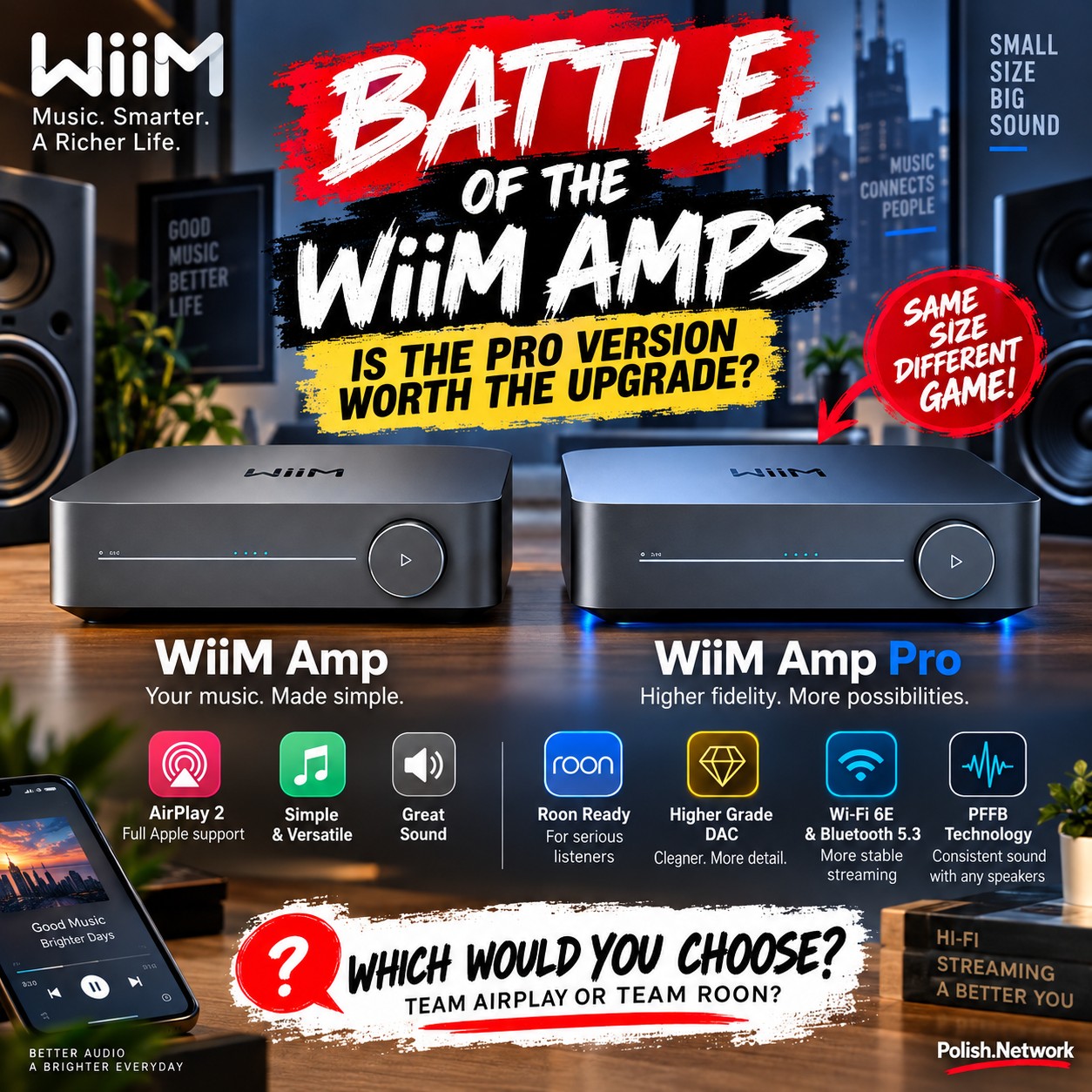
Same footprint. Same 60 W × 2 into 8 Ω / 120 W × 2 into 4 Ω power spec. Same HDMI ARC, same MM phono, same sub out, same WiiM Home app. Different electronics inside — and one hard-blocking feature difference.
- Buy the WiiM Amp (original, B0CGCLXH4H) if you’re an Apple household — it’s the only current WiiM Amp with full AirPlay 2 support.
- Buy the WiiM Amp Pro (B0DFPJ91ZX) if you don’t need AirPlay 2 — it sounds meaningfully cleaner (ES9038Q2M DAC + PFFB), measures dramatically better, adds Roon Ready certification, Wi-Fi 6E, Bluetooth 5.3, and runs cooler.
The trade-off is that simple: AirPlay 2 vs cleaner sound + Roon Ready. You cannot have both in one chassis today.
Two units, same shape, different generation
The WiiM Amp launched in 2023 and immediately became the community-standard sub-$300 streaming integrated on r/BudgetAudiophile — the “just buy it” answer to “how do I get streaming + DAC + amp + phono in one small box.” In 2025 WiiM released the WiiM Amp Pro: same chassis, same power output, upgraded electronics on the inside, and one licensing change (AirPlay 2 dropped) that forces a real decision on Apple households.
This is not a color-variant refresh. The Pro is a genuine second-generation upgrade with measurable improvements. But WiiM did not make the Pro a strict superset of the original — the original keeps AirPlay 2, the Pro does not. That single trade-off drives the whole buying decision.
The main comparison table
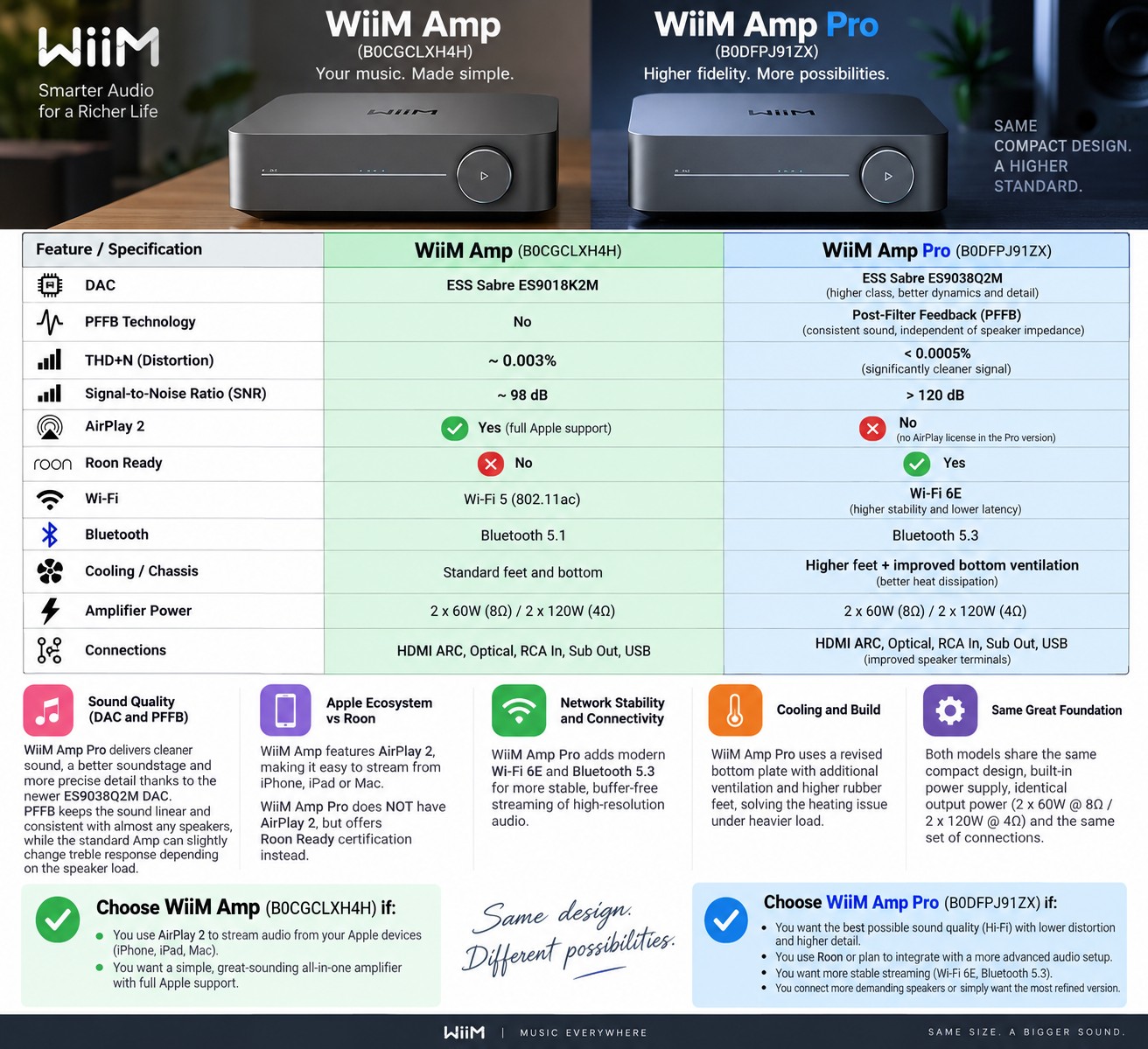
| Feature / Spec | 🟩 WiiM Amp (B0CGCLXH4H) | 🟦 WiiM Amp Pro (B0DFPJ91ZX) |
|---|---|---|
| Generation | 2023 (original / 1st-gen) | 2025 (2nd-gen upgrade) |
| DAC | ESS Sabre ES9018K2M | ESS Sabre ES9038Q2M (half-class higher, better dynamics + detail) |
| PFFB (Post-Filter Feedback) | No | Yes — eliminates load-dependency, holds tonal linearity with any speaker impedance curve |
| THD+N | ~0.003% | < 0.0005% (6× cleaner) |
| Signal-to-Noise Ratio | ~98 dB | > 120 dB (22+ dB quieter noise floor) |
| AirPlay 2 | 🟢 Yes (full Apple ecosystem support) | 🔴 No (Pro dropped AirPlay 2 licensing) |
| Roon Ready certification | 🔴 No (works with Roon via other protocols, no badge) | 🟢 Yes (certified endpoint) |
| Wi-Fi | Wi-Fi 5 (802.11ac) | Wi-Fi 6E (better stability, lower latency, less congestion) |
| Bluetooth | 5.1 | 5.3 (longer range, better power efficiency) |
| Thermal design | Standard bottom plate + feet | Vented bottom plate + taller feet (runs cooler at party volume) |
| Amplifier output | 60 W × 2 @ 8 Ω · 120 W × 2 @ 4 Ω (class-D) | 60 W × 2 @ 8 Ω · 120 W × 2 @ 4 Ω (class-D with PFFB) |
| I/O | HDMI ARC · Optical · Coax · RCA line · MM Phono · USB · Sub Out | HDMI ARC · Optical · Coax · RCA line · MM Phono · USB · Sub Out · upgraded binding posts |
| Room correction | Parametric EQ + UMIK-1 in WiiM Home app | Parametric EQ + UMIK-1 in WiiM Home app |
The four engineering upgrades that make the Pro sound better
1. ES9038Q2M DAC (up from ES9018K2M)
The ESS Sabre ES9038Q2M is a genuine class upgrade over the ES9018K2M — better dynamic range, better linearity, better jitter rejection. In A/B blind tests on r/BudgetAudiophile and Head-Fi, owners consistently report the Pro pulls more low-level detail out of well-mastered recordings — more air around vocals, more separation between instruments in dense mixes, tighter transient definition on percussion.
This is not marketing. The <0.0005% THD+N vs original’s ~0.003% is a real 6× improvement in distortion, and >120 dB SNR vs original’s ~98 dB is a 22+ dB deeper noise floor. That noise floor difference is audible on quiet passages of classical, ambient, and acoustic recordings where the original’s residual noise sits about where the softest musical detail lives.
2. Post-Filter Feedback (PFFB) — the big one
The original WiiM Amp uses a conventional class-D output stage where the feedback loop closes before the output filter. Result: the amp’s frequency response gains a slight tilt that depends on speaker impedance. Pair it with a well-behaved 8-ohm speaker and it measures flat; pair it with a speaker like HiVi-Swans D3.1 MkII that has a 6-ohm dip in the mid-bass or Wharfedale Diamond 12.1 that drops to ~4 ohms in specific bands, and the treble lifts subtly.
The Pro closes the feedback loop after the output filter (Post-Filter Feedback). This holds tonal linearity essentially regardless of what speaker you connect. Cheapaudioman, Erin’s Audio Corner, and iiWi Reviews have all demonstrated the measurable difference on modern class-D amps with PFFB vs without — the Pro is squarely in the “modern well-engineered class-D” camp, the original is the older “conventional class-D” topology.
3. Wi-Fi 6E + Bluetooth 5.3 (up from Wi-Fi 5 + Bluetooth 5.1)
Wi-Fi 6E adds the 6 GHz band and modern OFDMA scheduling. In dense apartment environments where the 2.4 GHz and standard 5 GHz bands are congested, Pro owners report rock-solid 24-bit/192 kHz FLAC and DSD streaming from Roon, Qobuz, and Tidal where the original would occasionally buffer. Bluetooth 5.3 similarly extends range and reduces interference — worthwhile in real-world household use.
4. Redesigned thermal management
Original WiiM Amp owners driving their systems at party volume for 3+ hours reported mild chassis warming — not a reliability problem, but noticeable. The Pro adds ventilation slots on the bottom plate and taller rubber feet to improve airflow underneath. Owners driving Klipsch RP-500M II or RP-600M II at reference SPL report the Pro stays noticeably cooler than the original under the same load.
The Apple vs Roon ecosystem trade-off (the deciding factor for most buyers)
🍎 If your household runs on Apple devices → buy the original
The WiiM Amp original (B0CGCLXH4H) is the only current WiiM Amp with a full AirPlay 2 license. That means:
- iPhone, iPad, Mac stream to the amp with one tap — no third-party app, no re-authentication.
- AirPlay 2 multi-room grouping with other AirPlay 2 speakers (HomePod, Sonos in AirPlay 2 mode, other AirPlay 2 hi-fi devices) works out of the box.
- Apple TV audio out to the WiiM Amp is native. So is Apple Music streaming, Apple Podcasts, Safari audio playback.
- Siri “Play [song] in the [room name]” works.
The Pro does not have AirPlay 2. You can get audio to the Pro from Apple devices via Chromecast (with the right app) or via Bluetooth or via Roon (if you own a Roon subscription), but the seamless native AirPlay 2 experience is only on the original.
🎼 If your household runs Roon → buy the Pro
The WiiM Amp Pro (B0DFPJ91ZX) is Roon Ready certified. That means:
- Your Roon core sees the Pro instantly as a certified endpoint — no manual configuration.
- Roon multi-zone playback with the Pro alongside other Roon Ready endpoints is stable, synchronized, dropout-free.
- Roon’s bit-perfect delivery through the Pro’s ES9038Q2M DAC is the whole point of running Roon in the first place.
The original WiiM Amp is not Roon Ready. Roon can still send audio to it via other network protocols in the WiiM Home app, but the certified Roon Ready endpoint experience is only on the Pro.
Complete recommended chain (works with either amp)
🛒 Full modern streaming hi-fi build sheet
- Amp — Apple household: WiiM Amp (original, B0CGCLXH4H, Space Gray).
- Amp — Roon / cleanest sound: WiiM Amp Pro (B0DFPJ91ZX).
- Amp — max absolute power / touchscreen alt: WiiM Amp Ultra.
- Passive bookshelves (detail-forward): Klipsch RP-500M II or RP-600M II.
- Passive bookshelves (imaging + PFFB payoff): HiVi-Swans D3.1 MkII.
- Passive bookshelves (warm British): Wharfedale Diamond 12.1.
- Passive bookshelves (budget baseline): Micca MB42X G2.
- Companion streamer (different room): WiiM Ultra.
- Alternative streaming source: Fosi Audio S3 or Eversolo DAC Z10.
- Turntable path: both amps have MM phono in — plug directly with Rega Planar 1, Pro-Ject Debut Carbon, or AT-LP60X.
- TV audio: both amps have HDMI ARC — one cable to the TV, CEC volume sync, real 2.0 hi-fi replaces every soundbar.
- Subwoofer: both amps have sub-out with adjustable 40–200 Hz crossover. Any active sub with RCA input works.
- Multichannel Atmos alternative: if you actually want 5.1+ home theater instead of 2.0 hi-fi, look at Onkyo TX-RZ50 or Denon AVR-X1800H receivers.
Frequently asked questions
Is the WiiM Amp Pro worth the price premium over the original?
If you don’t need AirPlay 2 — yes, unambiguously. The ES9038Q2M DAC + PFFB topology + Roon Ready + Wi-Fi 6E + cooler thermals is a meaningful engineering upgrade for a modest cost delta. The measurement improvements (6× lower THD+N, 22 dB deeper noise floor) are real and audible on well-mastered recordings. If you’re comparison-shopping any similar streaming integrated in the sub-$400 bracket, the Pro is the current answer.
Why did WiiM drop AirPlay 2 on the Pro?
Apple’s AirPlay 2 program requires per-device MFi (Made for iPhone) licensing fees plus certification cycles. WiiM has not publicly detailed the reason for dropping it on the Pro, but the most likely explanations are (a) licensing cost pressure at the Pro’s higher-tier feature set, or (b) prioritizing Roon Ready certification and native ecosystem apps as the primary streaming path. The community reaction has been mixed — Roon users cheer, Apple users are frustrated. WiiM has hinted at possibly restoring AirPlay 2 in a future firmware, but as of this writing it’s not available on the Pro.
Can I stream from iPhone to the WiiM Amp Pro at all?
Yes, but not via AirPlay 2 native. Options: (1) Chromecast built-in — if the source app supports Google Cast (Spotify, YouTube Music, etc.). (2) Bluetooth 5.3 — works from any phone but is lower quality than AirPlay 2. (3) Roon on iPhone — if you subscribe to Roon. (4) Native app integration — Tidal, Qobuz, Amazon Music, Spotify Connect all stream directly from the WiiM Home app on iPhone to the Pro. What you cannot do is one-tap AirPlay 2 send from any Apple audio source. If that specific workflow matters, buy the original.
Which one drives harder-to-drive speakers better?
Both amps output the same 60 W × 2 into 8 Ω / 120 W × 2 into 4 Ω, so the raw power envelope is identical. Where the Pro pulls ahead is with speakers that have swingy impedance curves — dropping to 4 ohms in some bands, rising to 10+ ohms in others. The Pro’s PFFB feedback keeps tonal linearity across those swings; the original will show a slight treble lift with certain loads. If your speakers are HiVi-Swans D3.1 MkII or Wharfedale Diamond 12.1 (both with real impedance excursions), the Pro is the audibly better match. If you’re driving Klipsch RP-500M II or Micca MB42X G2 (both fairly well-behaved impedance), the difference is smaller.
Do both amps support the same room correction workflow?
Yes. Both use the WiiM Home app with a UMIK-1 measurement microphone (~$80 extra) for parametric EQ and room correction. The workflow is identical. Room correction is arguably the single biggest sound-quality upgrade most owners can make regardless of which WiiM they buy.
What about the WiiM Amp Ultra — how does it fit in?
The WiiM Amp Ultra is the flagship — 3.5″ touchscreen, higher-tier DAC, higher power output, HDMI 2.1, higher price. Same Roon Ready + no AirPlay 2 licensing stance as the Pro (Ultra also does not have AirPlay 2 in current firmware). Choose Ultra over Pro if you want the touchscreen, want more headroom for a large room, or want HDMI 2.1 for a modern TV setup. Otherwise the Pro delivers most of the Ultra’s engineering benefit at a lower cost.
Should I keep my original WiiM Amp or upgrade to Pro?
If you actively use AirPlay 2 — keep the original. If you don’t use AirPlay 2 and you have revealing speakers (something in the HiVi D3.1 MkII / Klipsch RP-500M II tier or better), the Pro upgrade is audible enough to justify. If you don’t use AirPlay 2 and you’re driving Micca MB42X G2 class budget speakers, the improvement is smaller — the speakers become the limiting factor, not the amp.
Is the WiiM Amp / Pro enough amp for a big room?
120 W into 4 ohms is honest but not massive. For 15×17 ft+ rooms played loud, look at either the WiiM Amp Ultra for higher headroom or an external amp path like AIYIMA A20 MONO pair. For normal-sized living rooms (12×14 ft to 14×16 ft) at real listening SPL, both the WiiM Amp and Pro handle it cleanly.
Bottom line
The WiiM Amp Pro is objectively the better-engineered amplifier — cleaner DAC, PFFB feedback loop, better measurements, Roon Ready, Wi-Fi 6E, Bluetooth 5.3, cooler thermals, upgraded binding posts. If you don’t need AirPlay 2, buy the Pro and don’t look back.
But if AirPlay 2 is a real workflow feature in your household — iPhone streaming, Apple Music, Siri commands, AirPlay 2 multi-room grouping — the original WiiM Amp is genuinely the only current WiiM Amp that supports it. That trade-off doesn’t have a workaround. The original is not obsolete; it’s the AirPlay 2 pick in the family. Both are the “just buy it” answer in their respective use cases.