
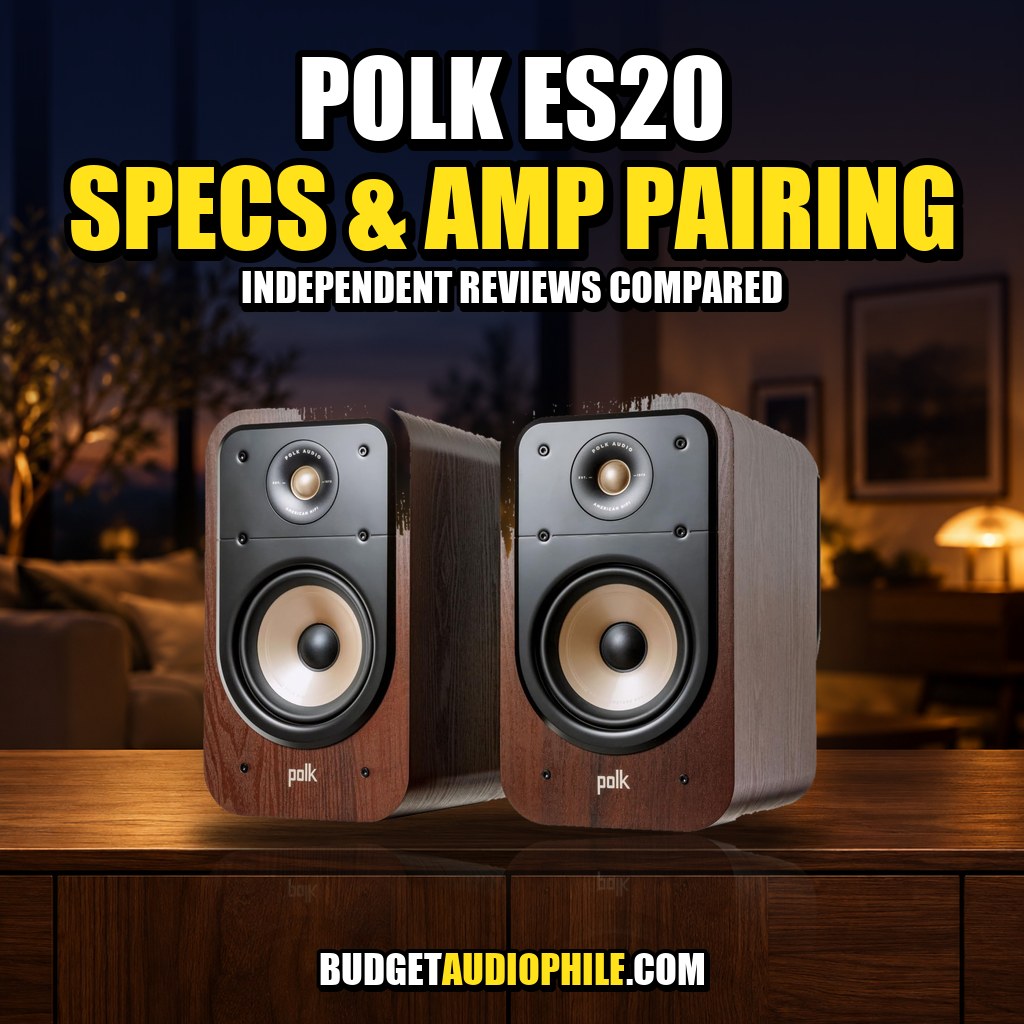
The Polk Signature Elite ES20 is a large passive bookshelf speaker with a 6.5-inch woofer, made for buyers who want real bass from stand-mounted boxes and who already own, or plan to buy, a stereo amplifier or AV receiver. Its published sensitivity is 86 dB and each cabinet is 13.8 inches deep, so it needs a capable amplifier and sturdy stands.
TL;DR
- Best for: listeners with an amplifier or receiver of 20 to 125 watts per channel who want a stereo pair or front speakers for a Dolby Atmos or DTS:X receiver.
- Main strength: bass output for the size. Audio Science Review measured the response 10 dB down near 35 Hz, though listening reviewers disagree on how deep it feels.
- Watch out for: a resonance near 600 Hz and raised treble in ASR’s measurements, an 86 dB rating that wants more power than efficient designs, and a deep cabinet.
- Compared to: the Klipsch RP-500M II lists 92 dB and a smaller cabinet, while the ES20 lists the lower bass figure and the larger woofer.
- Bottom line: a sensible front pair if you have the room and at least 20 watts per channel. For a desk or a very low-power amplifier, read the alternatives first.
Checked on 2026-10-31. Specifications come from Polk’s product page and information sheet. Sound descriptions come from four reviews we read in full: Audio Science Review (May 2022), audioFi.net (November 2022), PHILE WEB (April 2023, labeled PR) and iine.me (April 2026). Owner feedback is the summary on our product page.
What we did not verify: we did not listen to, measure or own the ES20, so every sound description belongs to the reviewer named beside it. We could not confirm what the walnut finish is made of, how the speaker wall-mounts, or how it ages. Amplifier pairings are arithmetic from published ratings.
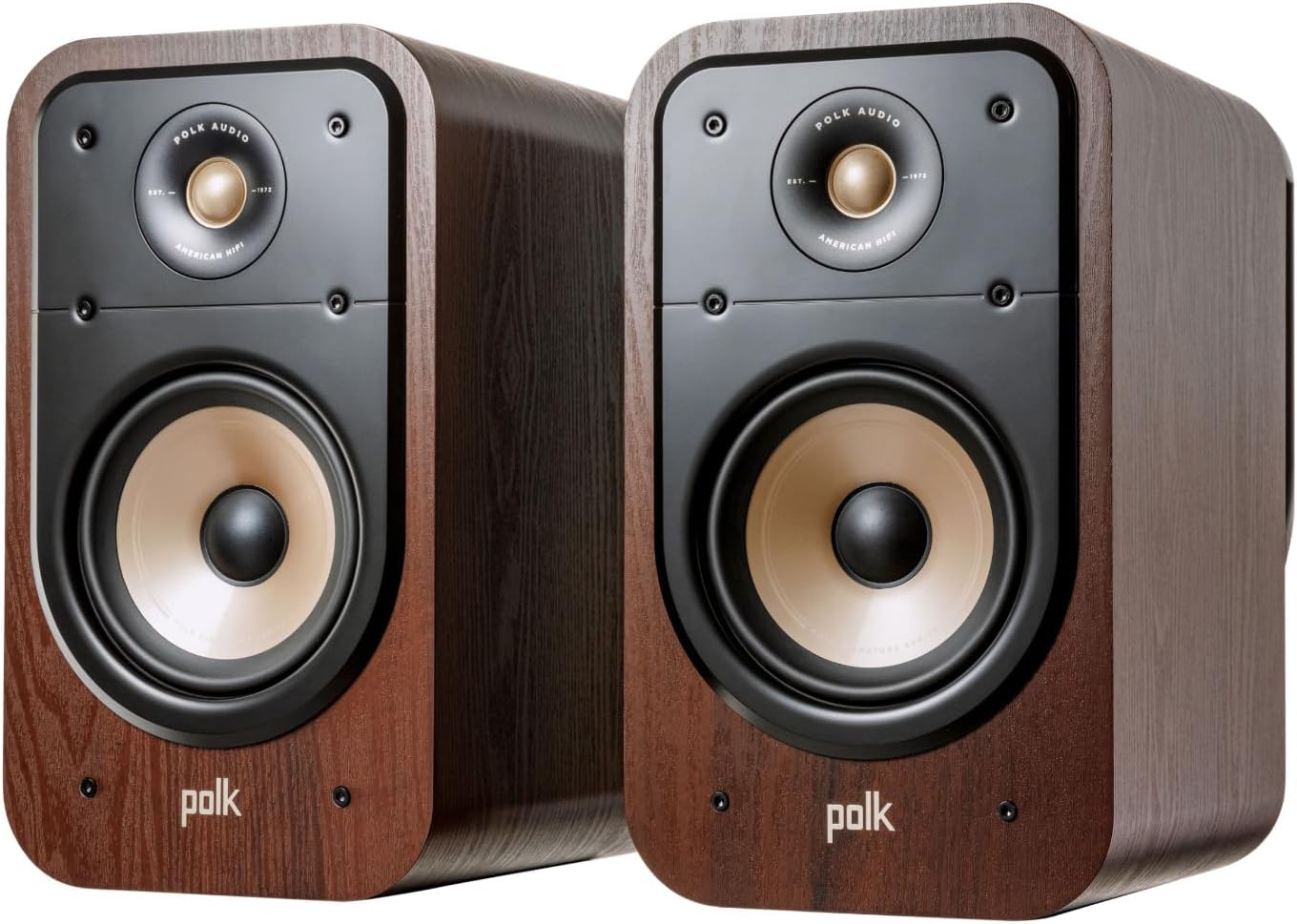
Polk Signature Elite ES20 specifications
| Spec | Polk’s figure |
|---|---|
| Type | Passive two-way, bass-reflex with Power Port |
| Drivers (each) | 6.5-inch (16.5 cm) mica-fortified polypropylene woofer, 1-inch (2.54 cm) Terylene dome tweeter |
| Crossover | 2.4 kHz |
| Sensitivity | 86 dB (2.83 V at 1 m) |
| Frequency response | 41 Hz to 40 kHz (tolerance not stated) |
| Recommended amplifier power | 20 to 125 watts per channel |
| Impedance | Compatible with 4-ohm and 8-ohm outputs |
| Size (each) | 8.5 W × 14.8 H × 13.8 D in (21.6 × 37.6 × 35.1 cm) |
| Weight (each) | 17 lb (7.7 kg) |
| Inputs | One pair of gold-plated five-way binding posts |
| Finishes (Polk US page) | Black, White, Brown |
| Certifications, warranty | Hi-Res Audio certified, Dolby Atmos and DTS:X compatible, limited five-year warranty |
Source: Polk’s ES20 product page and Polk’s ES15/ES20 information sheet, read on 2026-10-31. The product page lists a damped Medite MDF cabinet and a removable magnetic grille.
What is the Walnut finish on our listing?
Polk’s US page offers the ES20 in Black, White and Brown, and retailers such as Abt call the brown version Walnut. They appear to be the same item: Polk’s page data lists part number 300364-14-00-005, and Abt’s Walnut listing carries the same digits in its item number. Our button opens the Walnut listing on Amazon, where the other finishes can also be selected.
Polk’s page does not say whether the brown finish is real wood veneer or a wrap. Lim Juan of audioFi.net described the woodgrain option as faux woodgrain, and our product page records one owner who returned a pair over the simulated grain. Klipsch’s own spec sheet for the RP-500M II calls its walnut finish vinyl. Assume a wrap unless the seller says otherwise.
What amplifier power does 86 dB imply?
Sensitivity is the level a speaker produces at 1 meter from 2.83 volts, which is 1 watt into an 8-ohm load, and each tenfold increase in power adds 10 dB. The table is arithmetic from Polk’s 86 dB figure for one speaker, with no room gain and no allowance for peaks. Real rooms and 4-ohm loads shift the numbers by a few decibels.
| Power per speaker | Level at 1 m (3.3 ft) | Level at 10 ft (3 m) |
|---|---|---|
| 1 W | 86 dB | 76 dB |
| 10 W | 96 dB | 86 dB |
| 25 W | 100 dB | 90 dB |
| 50 W | 103 dB | 93 dB |
| 100 W | 106 dB | 96 dB |
The Klipsch RP-500M II spec sheet lists 92 dB. A 6 dB gap means the ES20 needs about four times the power for the same level, so 10 watts into the Klipsch corresponds to roughly 40 watts into the ES20. Those are two manufacturer numbers, and Klipsch’s footnote says its figure is measured half-space anechoic while Polk does not state its method. A forum member in the ASR thread calculated about 87.7 dB for the ES20 from Amir’s measurement, a little above Polk’s current rating.
Lim Juan drove the ES20 with a 35-watt class A tube-hybrid amplifier and a 50-watt Pioneer integrated amplifier without trouble. Amir at ASR wrote that, pushed too far, the woofer loses deep bass and sounds tubby.
Which amplifiers we sell pair with the ES20?
All three amplifiers clear Polk’s 20-watt minimum by a wide margin. Headline class D ratings depend on load, supply voltage and distortion, so read each maker’s full sheet.
| Amplifier | Published output | Features listed | Store price, checked 2026-10-31 |
|---|---|---|---|
| Fosi Audio ZA3 | Up to 155 W stereo or 235 W mono, per Fosi’s store text (load not stated) | TPA3255 chip, balanced XLR and 1/4-inch TRS combo input, 12 V trigger | $109.99 amplifier only, $129.99 with a 32 V/5 A supply, $149.99 with a 48 V/5 A supply Check price at Fosi |
| Fosi Audio BT20A MAX | “300 W per channel” headline on Fosi’s store (load not stated) | TPA3255 chip, Bluetooth with LDAC and aptX codecs, dual RCA inputs, subwoofer output, remote | $249.99 with a 48 V/5 A supply, $279.99 with the GaN supply Check price at Fosi |
| AIYIMA A20 | With a 48 V/5 A supply, 2 × 100 W into 8 ohms and 2 × 120 W into 4 ohms. With a 48 V/10 A supply, 2 × 150 W and 2 × 250 W. Source: a distributor listing | TPA3255 chip, XLR and RCA inputs, subwoofer output | $205.99 with a 48 V/5 A supply, $240.99 with a 48 V/10 A supply Check price at AIYIMA |
Pick the Fosi BT20A MAX if you stream by Bluetooth, the ZA3 if you have a balanced source, and the A20 if you want XLR and RCA inputs plus a subwoofer output in one chassis. Our AIYIMA A20 MONO vs Fosi ZA3 comparison covers the monoblock A20 against the ZA3.
Where do the independent reviewers agree and disagree?
Two sources carry their own limits: PHILE WEB labels its article as PR, and iine.me is a single-author blog that does not name its amplifier.
| Topic | Audio Science Review (Amir, May 2022) | audioFi.net (Lim Juan, Nov 2022) | PHILE WEB, part 1 and part 2 (Apr 2023) | iine.me (Apr 2026) |
|---|---|---|---|---|
| Method | Klippel scan, then listening with equalization | Listening, 35 W and 50 W amplifiers | Listening, FirstWatt F7 amplifier | Listening, equipment not stated |
| Bass | Deeper than expected, 10 dB down near 35 Hz; port resonance adds muddiness | Punchy and well timed; limited extension | Controlled, not especially deep | Weighty and tight, works without a subwoofer |
| Midrange | Resonances between 600 and 1000 Hz before equalization | Open, clear, natural voices | Clear and natural | Full-bodied, slightly mellow |
| Treble | Raised, bright on tracks without bass | Even and nicely extended | Smooth and pleasant | Glossy, polished |
| Verdict | Recommended as is, more so with equalization | Recommended; sound 8.5/10, value 8/10 | Strongly positive, excellent value | Exceptional value if you have the room |
They agree on the verdict: all four recommend the ES20. Two also flag the cabinet’s size (audioFi.net and iine.me). ASR measured low distortion at moderate levels and liked the smooth, wide horizontal dispersion, and audioFi.net described an even, cohesive sound.
They disagree on three points. Bass depth: ASR measured more extension than it expected, while audioFi.net and PHILE WEB heard punch without great depth. Treble: ASR measured and heard raised output, while the other three describe it as extended, smooth or polished. Midrange: only ASR measured a resonance near 600 Hz that muddies the upper bass and lower midrange. Rooms and amplifiers differ, so the reviews do not isolate a cause. Amir concluded that both flaws are excess output that equalization removes.
Where should the ES20 go? Placement and port notes
Polk’s page gives no placement or room-size guidance, so these notes are the reviewers’ own.
- Lim Juan listened about 14 inches (35 cm) from the front wall in a small room and out to about 35 inches (90 cm) in a larger one, found the ES20 less prone to boominess than other rear-ported speakers, and liked slight toe-in. The 24-inch (60 cm) stands worked better in a four-pillar design.
- The iine.me reviewer says the cone-shaped rear port reduces wall interference but still recommends some clearance.
- Posters in the ASR thread floated plugging the port when a subwoofer is in use and damping the port. Those are forum opinions we did not test.
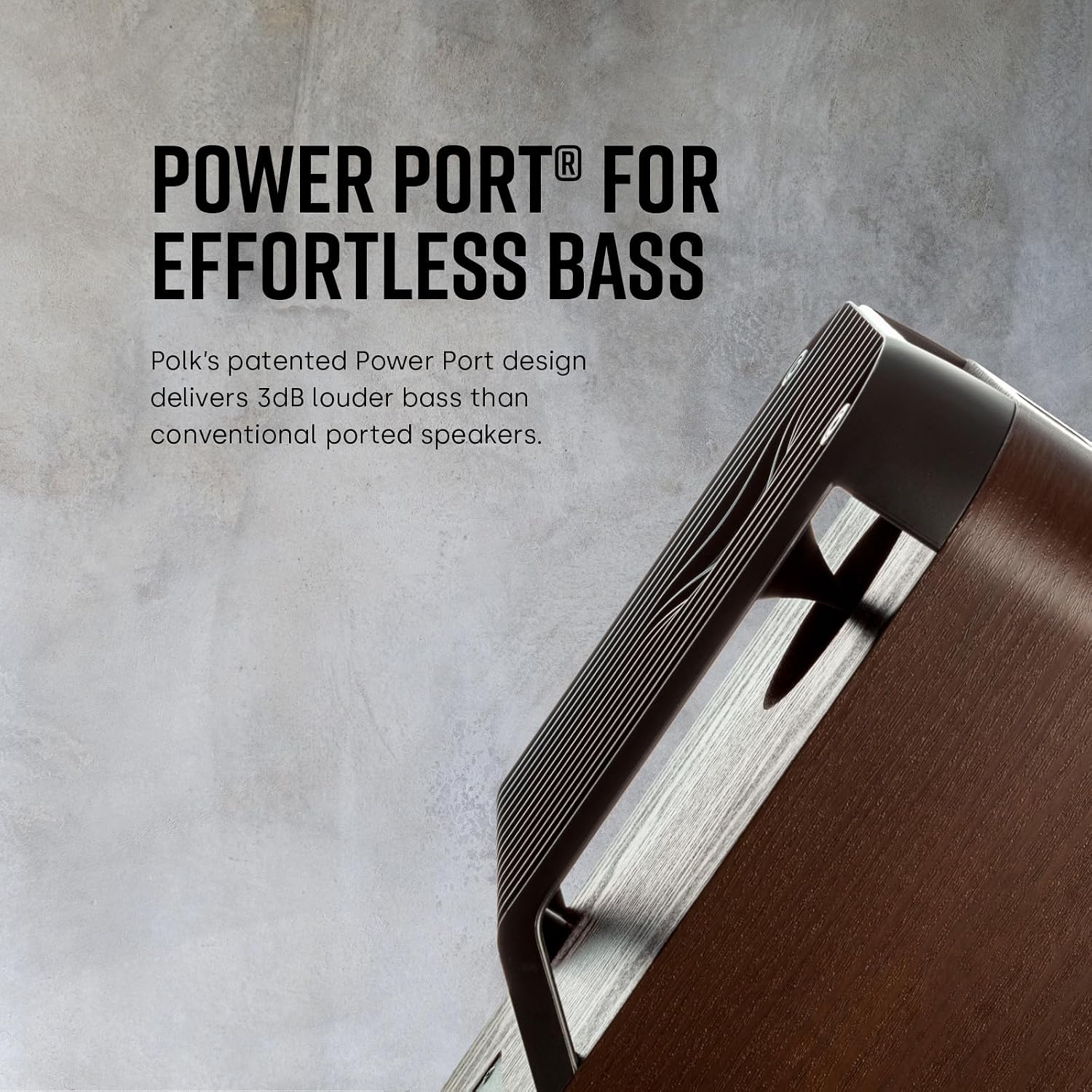
Polk describes Power Port as a patented shaped port that smooths airflow. audioFi.net repeats Polk’s claim of about 3 dB more bass than a conventional port and did not test the pair with the plate removed.
ES20, S20, ES15 and the 86 vs 88 dB question
The older Signature S20 is archived, and Polk’s S20 page labels the ES20 as the latest version. The smaller ES15 lists a 5.25-inch woofer, 85 dB and 20 to 100 watts in Polk’s information sheet. The ES20’s own sensitivity figure also moved: audioFi.net and the 2022 ASR thread quote 88 dB, while Polk now lists 86 dB. We found no explanation, so size an amplifier for roughly 86 to 88 dB.
Polk ES20 vs Klipsch RP-500M II, HiVi-Swans D3.1 MkII, Micca MB42X G2 and Sony SS-CS5M2
| Speaker | Drivers | Published sensitivity | Published low end | Pick it over the ES20 when |
|---|---|---|---|---|
| Polk ES20 | 6.5-inch woofer, 1-inch Terylene dome | 86 dB | 41 Hz (no tolerance stated) | The baseline: room for a 14.8-inch cabinet and 20 W or more. |
| Klipsch RP-500M II | 5.25-inch Cerametallic woofer, 1-inch titanium tweeter on a Tractrix horn | 92 dB (2.83 V, 1 m) | 50 Hz ±3 dB | Your amplifier is modest or you want more volume per watt from a smaller cabinet (13.56 × 6.81 × 10.65 in). You give up the ES20’s lower published bass figure. |
| HiVi-Swans D3.1 MkII | 6.5-inch woofer, 28 mm dome tweeter, per a retailer listing | No consistent figure found | Listings conflict | You want a lesser-known 6.5-inch two-way and accept thinner published data. We know of no independent measurement of it. |
| Micca MB42X G2 | 4-inch carbon-fiber woofer, 0.75-inch silk dome | 86 dB (1 W, 1 m) | 55 Hz | Space is tight: it measures 9.5 × 5.8 × 6.5 in. Expect less bass from the 4-inch driver. |
| Sony SS-CS5M2 | Three-way, three drivers | No official figure found; Archimago estimates about 88 dB | Measured 6 dB down near 60 Hz | You plan a subwoofer near 80 Hz, as Archimago suggests, or want an easy load: Sony rates 6 ohms and Archimago measured a minimum near 5.6 ohms. |
Sources: Klipsch spec sheet, Micca’s product page and Archimago’s November 2025 measurements. Manufacturer low-end figures use different methods and are not a like-for-like test. ASR’s data shows the ES20 10 dB down near 35 Hz, and the spinorama.org listing puts the 6 dB point near 45 Hz, so Polk’s 41 Hz sits inside the roll-off.
Owner feedback summarized from retailer reviews
This paraphrases the summary on our Polk ES20 product page, drawn from verified-purchase review excerpts dated 2023 to 2026. It is not a count.
- Owners describe a full sound that fills a living room or office, with more bass than they expected. Some run a 2.0 system and others add a subwoofer for movies.
- Vocals and dialogue are called clear, and owners use the pair as front or surround speakers with Marantz, Yamaha, Fosi and Onkyo gear.
- The consistent warning is depth, and some buyers say floor stands suit the ES20 better than a shallow shelf.
- Opinions on the Walnut look differ. One reviewer found the treble harsh at first and preferred it after several hours, a personal account and not evidence of break-in.
Who should buy the ES20, and who should skip it
Skip or look elsewhere if you have a desk or a shallow shelf, plan to run a very low-power amplifier, or want a flat tonal balance without applying equalization.
Buy it if you have space for a 14.8-inch cabinet, an amplifier or receiver of at least 20 watts per channel, and a taste for a full, forward presentation. A subwoofer is optional, since the sources split on the pair’s bass.
The button opens the Walnut ES20 listing on Amazon, and other finishes can be selected there. Budget Audiophile may earn a commission from qualifying purchases through links marked as sponsored; this does not change what we write. Time-limited offers are covered in the current deal post.
Polk ES20 FAQ
Is the Polk ES20 good?
Does the Polk ES20 need an amplifier?
How much power does the Polk ES20 need?
Is the Polk ES20 4 ohm or 8 ohm?
Does the Polk ES20 need a subwoofer?
Is the Polk ES20 86 dB or 88 dB?
How does the Polk ES20 compare with the Klipsch RP-500M II?
Is Walnut the same finish as Brown on Polk’s site?
Are the Polk ES20 speakers bright?
Where can I see the current ES20 price or sale?
Update log
- 2026-10-31: first version. Specifications checked against Polk’s product page and information sheet, four reviews read, amplifier details checked on the Fosi and AIYIMA stores.