
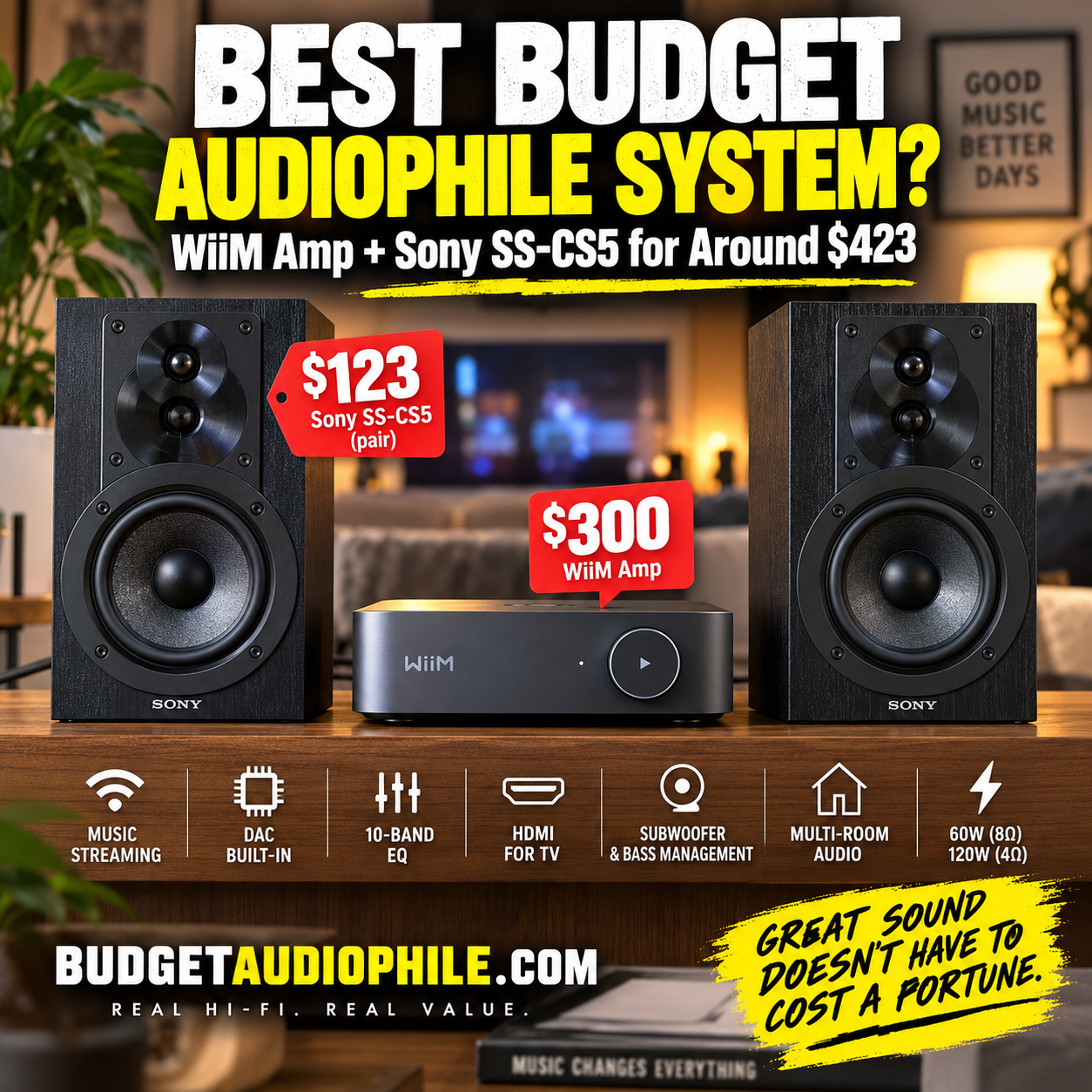
🎯 The short version — what this system is and why it works
For roughly $423 before cables and tax (~$500 with everything) you get a genuinely capable Hi-Fi system that streams, decodes, amplifies, handles TV audio, integrates a subwoofer, and does room-corrective EQ — all from two boxes.
- Amp: WiiM Amp (original, B0CGCLXH4H) — ~$300. Streaming + DAC + preamp + amp + HDMI ARC + phono + sub-out + EQ + AirPlay 2 + multi-room in one small chassis.
- Speakers: Sony SS-CS5M2 (the current 3-way, 3-driver refresh of the classic SS-CS5) — ~$123 per pair on sale.
- Total: ~$423 for a complete two-channel streaming Hi-Fi setup with a clear upgrade path.
🛒 Get the complete system (~$423)
If you are searching for the best budget audiophile system, there is one mistake I want you to avoid immediately:
Do not assume that becoming an audiophile means spending thousands of dollars. It doesn’t.
One of the biggest changes in Hi-Fi over the last several years is how much technology has moved down into affordable equipment. Streaming, DACs, DSP, EQ, HDMI, subwoofer management and powerful class-D amplification no longer require a rack full of expensive components. Today, you can put together a genuinely capable budget Hi-Fi system for around $423 before cables and tax.
My starting point is the WiiM Amp paired with a pair of Sony SS-CS5M2 bookshelves — at the right prices, this may be one of the most interesting first audiophile systems you can build in 2026. And more importantly, it demonstrates exactly what Budget Audiophile is supposed to mean: not cheap equipment just because it is cheap, but maximum sound, features and flexibility for the money.
The best budget audiophile system doesn’t have to be expensive
When someone decides to build a first real stereo system, the process can become confusing very quickly. You start looking for an amplifier. Then someone tells you that you need a DAC. Then a streamer. Then a preamp. Then special cables. Then a separate headphone amplifier. Then a power conditioner. And suddenly the simple stereo system you wanted costs $2,000, $5,000 or more.
That approach can be fun if you enjoy experimenting with equipment. But it is absolutely not necessary to start enjoying high-quality audio. This is where products like the WiiM Amp completely change the conversation.
WiiM Amp: one box does almost everything
The WiiM Amp is interesting because it replaces several traditional Hi-Fi components with one compact device. For roughly $300, you get:
- stereo class-D amplification (60 W × 2 into 8 Ω, 120 W × 2 into 4 Ω)
- network music streaming (Spotify Connect, Tidal, Qobuz, Amazon Music, Deezer, TuneIn)
- built-in ESS Sabre DAC
- preamp functionality
- HDMI ARC connectivity for the TV
- parametric EQ and room correction (via UMIK-1)
- subwoofer output with adjustable 40–200 Hz crossover
- bass management
- multi-room audio (WiiM Home app + AirPlay 2)
- full AirPlay 2 support — key for Apple households (the newer WiiM Amp Pro dropped this)
- MM phono input for a turntable
That is a lot of functionality for one relatively inexpensive component. For someone building a budget audiophile system, this is exactly the type of product I like — instead of spending most of your budget on electronics, you can put more money toward speakers, a subwoofer, or simply keep the total system price reasonable.
🎯 Ready to buy the WiiM Amp?
Why the WiiM Amp is such a good first audiophile amplifier
A traditional integrated amplifier can sound fantastic. But many affordable integrated amps still require you to add other devices if you want streaming or television integration. The WiiM Amp gives you those features from the beginning. You can use it for music. You can connect it to your television. You can add a subwoofer. You can create a multi-room system. And you can control the tonal balance using EQ.
That last feature is especially important.
EQ is one of the most valuable features in budget Hi-Fi
Audiophiles sometimes talk about EQ as if using it somehow makes your system less legitimate. I disagree.
Your room changes the sound of your speakers. Speaker placement changes the sound. Furniture changes the sound. Distance from the walls changes the sound. Even two speakers with excellent measurements can sound very different depending on where they are installed.
With an affordable speaker like the Sony SS-CS5M2, EQ becomes even more useful. If the treble sounds too aggressive in your room, you can pull it back a couple of dB in the WiiM Home app. If the low frequencies need a little more energy, you can add a shelf below 100 Hz. If your room creates an unpleasant frequency peak — every room has at least one — you have real tools available to address it.
That flexibility can make an inexpensive system considerably more enjoyable. And that matters much more to me than whether someone on an audiophile forum approves of using EQ.
Sony SS-CS5 / SS-CS5M2: one of the best budget bookshelf speakers?
The next part of the system is the Sony SS-CS5M2 — the current 3-way, 3-driver refresh of the classic SS-CS5 that has been discussed in budget Hi-Fi circles for over a decade. When these drop to around $123 per pair on sale, they become extremely difficult to ignore.
Is it the best bookshelf speaker ever made? No. Is it perfect? Absolutely not. But that is the wrong question. The correct question is:
How much speaker are you getting for approximately $123?
And the answer is: a surprising amount.
The Sony SS-CS5M2 uses a multi-driver configuration — a 5¼” foamed-mica woofer, a 1″ polyester main tweeter, and a 0.75″ super tweeter reaching up to 50 kHz for Hi-Res compatibility. The sound is lively, detailed and exciting. Some listeners love that presentation. Others find the upper frequencies too energetic. And that is exactly why pairing them with the WiiM Amp makes so much sense — if the Sonys are a little too bright in your room, you have EQ available.
🎵 Grab the Sony SS-CS5M2 pair
Don’t overpay for the Sony SS-CS5M2
This part is important. I like the Sony SS-CS5M2 as a budget audiophile speaker primarily when the price is right.
Historically, Sony’s SS-CS5 pricing has moved around considerably. Around $123 per pair, they are a fantastic value. At significantly higher prices, however, the competition becomes much stronger — the Wharfedale Diamond 12.1, Micca MB42X G2, and HiVi-Swans Oasis 140 all become worth cross-shopping.
That is an important Budget Audiophile rule: a great product at the wrong price can become a bad deal. Never buy something simply because somebody on YouTube called it the best budget speaker. Always look at what else is available at the current price.
WiiM Amp + Sony SS-CS5M2 price breakdown
| Component | Approximate price |
|---|---|
| WiiM Amp (original) | ~$300 |
| Sony SS-CS5M2 (pair, on sale) | ~$123 |
| System total | ~$423 |
| Add basic speaker wire + sales tax | ~$500 all-in |
For that money, you get a true two-channel stereo system, music streaming, DAC, HDMI for television, EQ, subwoofer output, bass management, AirPlay 2 multi-room support, and an easy future upgrade path. That is why I think this deserves serious consideration as one of the best stereo systems under $500 you can build in 2026.
🔥 The complete $423 system
One click each — add to cart, done.
Can you build a real audiophile system under $500? Yes.
An audiophile is simply somebody who cares about sound quality. There is no minimum required budget. You do not suddenly become an audiophile when your amplifier crosses $2,000. You don’t need $10,000 speakers. You don’t need cables that cost more than your television. If you carefully choose your equipment, understand your room and make good use of DSP or EQ, an inexpensive stereo system can sound extremely impressive. The WiiM Amp and Sony SS-CS5M2 combination is a great example.
WiiM Amp power: is 60 watts enough?
The WiiM Amp is rated at approximately 60 W per channel into 8 Ω and 120 W per channel into 4 Ω. That is plenty of power for many normal listening situations and many bookshelf speakers.
Does that mean the WiiM Amp can drive every speaker on the market? Of course not. Some large or inefficient speakers require substantially more current and amplifier power. But that misses the point. This is a roughly $300 all-in-one streaming amplifier. Our expectations should remain realistic.
For a typical budget bookshelf setup like the SS-CS5M2 (or Klipsch RP-500M II, HiVi-Swans D3.1 MkII, Wharfedale Diamond 12.1, Micca MB42X G2), the available power can be more than enough for real living-room listening.
Bass management is one of the WiiM Amp’s best features
This feature may be even more important than raw amplifier power. When you add a powered subwoofer to the WiiM Amp’s sub-out, the amp can help divide the frequency workload between the subwoofer and your main speakers. Instead of asking a small bookshelf speaker to reproduce deep bass, you send those lower frequencies to the subwoofer.
A reasonable starting crossover point for many bookshelf systems is around 70–80 Hz, although the ideal setting depends on the speakers, subwoofer, listening position and room. This gives you several potential advantages: your bookshelf speakers do not have to work as hard reproducing deep bass; your amplifier has less low-frequency demand; your system can potentially play cleaner; and a properly integrated subwoofer can dramatically improve the listening experience. For a product at this price level, having real bass management is a major advantage.
🎯 Ready to buy the WiiM Amp?
This is also a great budget TV audio system
Another reason I recommend this type of system to beginners is HDMI ARC connectivity. Most people do not have separate rooms for television and music — your living room is probably doing both jobs. So why buy a soundbar for television and then build another system for music?
With HDMI ARC, the WiiM Amp can become the center of a combined music and TV system. Connect your television with one HDMI cable, connect your speakers, and now the same stereo system you use for Spotify or Tidal can also handle movies, television shows and YouTube — with CEC volume sync from your TV remote. For many people, that makes far more sense than owning several unrelated audio systems.
WiiM Amp multi-room audio changes the value equation
Here is another way to look at the price. Imagine spending $1,500 on one traditional audio system. Nothing wrong with that. But you could potentially put several WiiM-based systems around the house for similar money — living room, bedroom, office, kitchen. Now your music can follow you through your home. The same album or playlist can continue playing when you walk from one room into another via AirPlay 2 multi-room grouping.
For some listeners, that is considerably more valuable than putting the entire budget into a single amplifier.
⚡ Or upgrade the amp path
What should you upgrade first?
One reason this is such a good first audiophile system is that you do not have to replace everything when you want better sound. You can upgrade gradually.
Upgrade 1: Add a subwoofer
This would probably be my first upgrade. A good powered subwoofer can transform an inexpensive bookshelf system. Set the WiiM Amp’s crossover at 70–80 Hz and the character of the whole system changes.
Upgrade 2: Upgrade the speakers
Keep the WiiM Amp and eventually move to better bookshelf or floorstanding speakers. Natural upgrade path from the Sony SS-CS5M2: Klipsch RP-500M II for more detail and horn dynamics; HiVi-Swans D3.1 MkII for wider soundstage and better imaging; Wharfedale Diamond 12.1 for warmer British tuning.
Upgrade 3: Improve speaker placement
This costs nothing. And sometimes it produces a bigger improvement than buying new equipment. Try pulling the Sonys 2 feet away from the wall, toeing them in slightly, and equalizing distance to your listening seat.
Upgrade 4: Add speaker stands
Proper positioning at ear height when you sit can make a significant difference in imaging and bass performance.
Upgrade 5: Tune the EQ
Essentially free. Get a UMIK-1 measurement mic (~$80), run the WiiM Home app’s room correction, apply the parametric EQ curve. This is arguably the single biggest sound-quality upgrade most owners can make.
Upgrade 6: Move to the WiiM Amp Pro or Amp Ultra later
If you eventually want cleaner measurements + Roon Ready certification, the WiiM Amp Pro is the drop-in electrical upgrade (same chassis size, ES9038Q2M DAC, PFFB feedback loop, Wi-Fi 6E). Trade-off: the Pro dropped AirPlay 2 licensing — so only upgrade if you don’t rely on Apple’s AirPlay 2 workflow. If you want a touchscreen + more power, look at the WiiM Amp Ultra. See our full WiiM Amp vs WiiM Amp Pro comparison for the deep engineering breakdown.
That last point is important. The cheapest upgrade in Hi-Fi is learning how to use the equipment you already own.
Budget audiophile doesn’t mean cheap audio
This is the philosophy behind Budget Audiophile. I am not interested in finding the cheapest amplifier simply because it is cheap. I want equipment that provides unusually high performance or functionality for its price. Sometimes that means spending $100. Sometimes $300. Sometimes considerably more.
The goal is not “how little money can I possibly spend?” — it’s “where am I getting the most Hi-Fi for every dollar?” That is a very different question.
Do you really need a $1,500 amplifier?
Maybe. It depends on your speakers, room, listening habits and expectations. High-end equipment absolutely has its place. There are fantastic amplifiers that cost thousands of dollars. There are speakers worth owning that cost more than some cars. I am not against expensive audio — I love good equipment.
But I am against convincing beginners that expensive equipment is the only way into this hobby. That simply isn’t true anymore. The technology available in products like the WiiM Amp proves it.
🛒 Get the complete system (~$423)
My verdict: one of the best budget Hi-Fi systems you can build in 2026
If somebody came to me today and said:
“Artur, I want my first real stereo system. I want streaming, good sound, TV connectivity and the option to add a subwoofer later. I don’t want to spend thousands.”
The WiiM Amp + Sony SS-CS5M2 combination would absolutely be on my shortlist. Especially if the Sony speakers were available around the $123 price point.
For approximately $423 before cables and tax, you get an enormous amount of capability. More importantly, you get a system that can grow with you. And that, to me, is what a great budget audiophile system should do.
The bigger story: Hi-Fi has never been this accessible
The most exciting thing here isn’t actually the WiiM Amp. It isn’t the Sony speaker either. The bigger story is what is happening to affordable Hi-Fi.
Class-D amplification keeps improving. Streaming technology keeps getting cheaper. DAC performance continues to climb. DSP is becoming mainstream. Room correction is becoming more accessible. Bass management is appearing in inexpensive components. Features that used to require several separate boxes are being integrated into affordable devices.
For someone getting into Hi-Fi today, that is fantastic news. I genuinely believe there has rarely been a better time to become a budget audiophile.
Frequently asked questions
What is the best budget audiophile system under $500?
One strong option is the WiiM Amp combined with a pair of Sony SS-CS5M2 bookshelf speakers when the Sonys are available around the $123 sale price. The combination offers streaming, amplification, HDMI ARC, EQ, DAC functionality, subwoofer output, bass management and AirPlay 2 multi-room for roughly $423 before cables and taxes.
Is the WiiM Amp good for beginners?
Yes. The WiiM Amp is particularly attractive for beginners because it combines several components into one device. You do not need to immediately buy a separate streamer, DAC and amplifier — it’s all in one small chassis with the WiiM Home app handling setup.
Is the WiiM Amp good enough for audiophile listening?
For many affordable and moderately demanding speakers, absolutely. It provides a strong combination of sound quality, streaming features, EQ, bass management and convenience. More difficult speakers may benefit from more powerful amplification — see the WiiM Amp Pro for cleaner measurements or the WiiM Amp Ultra for higher power ceiling.
Are Sony SS-CS5 / SS-CS5M2 speakers audiophile speakers?
The Sony SS-CS5M2 is commonly discussed as an affordable entry-level Hi-Fi speaker. Whether someone considers it “audiophile” is less important than whether it sounds good in your room and provides good value at the price you pay. At $123 per pair on sale, the value is extremely hard to beat.
How much should I pay for Sony SS-CS5M2 speakers?
I find them most compelling when they are heavily discounted, around the $123-per-pair range discussed in this system. If the price is significantly higher, compare them against Micca MB42X G2, Wharfedale Diamond 12.1, or HiVi-Swans Oasis 140 before buying.
Does the WiiM Amp need an external DAC?
No. The WiiM Amp already includes an ESS Sabre digital-to-analog converter, so an external DAC is not required for a basic system.
Can I connect a subwoofer to the WiiM Amp?
Yes. One of the WiiM Amp’s most useful features is subwoofer integration and bass management via the RCA sub-out with an adjustable 40–200 Hz crossover.
What crossover should I use with bookshelf speakers?
Around 70–80 Hz can be a reasonable starting point for many bookshelf speakers, but the best crossover depends on the specific speakers, subwoofer and room. For the SS-CS5M2 specifically, 80 Hz is a good default.
Can the WiiM Amp work with a TV?
Yes. HDMI ARC connectivity makes the WiiM Amp useful as both a music amplifier and part of a television audio system, with CEC volume sync from your TV remote.
Is 60 watts per channel enough?
For many bookshelf speakers and normal home listening levels, yes. Difficult, inefficient or extremely large speakers may require more powerful amplification like the AIYIMA A20 MONO pair separates chain.
Should I buy a soundbar or WiiM Amp and speakers?
If music quality matters to you, a traditional stereo pair driven by the WiiM Amp can provide better stereo separation and a more flexible upgrade path than most soundbars. A soundbar may still be more convenient for users who prioritize simplicity over sound quality.
What should I upgrade first in a budget audiophile system?
Before replacing the amplifier, experiment with speaker positioning and EQ. After that, adding a good powered subwoofer or upgrading the speakers will often provide the largest audible improvement.
So, what would you build for $500?
This is where I want the Budget Audiophile community involved. If you had approximately $500 to build a complete stereo system today, what would you buy?
Would you choose WiiM Amp + Sony SS-CS5M2? Would you spend less on the amplifier and more on speakers? Would you buy used? Would you choose another bookshelf speaker like the Micca MB42X G2 or Wharfedale Diamond 12.1 around the same price? Or do you know an amplifier around $300 that delivers an even better combination of streaming, HDMI, EQ, bass management and amplification?
Put your system in the comments. Give us the amplifier, speakers and total price. Let’s see who can build the best budget audiophile system for the money.
Watch: another audiophile reached the same conclusion
I’m attaching a video below from another audio enthusiast who came to essentially the same conclusion. What I find particularly interesting is that his argument is almost identical to mine:
Modern affordable Hi-Fi has become so capable that you simply do not need to spend a fortune to build a genuinely enjoyable stereo system.
He also points directly to the WiiM Amp and Sony SS-CS5 as an exceptionally high-value combination. Watch the full breakdown:
🔥 The complete $423 system
One click each — add to cart, done.
Then come back and tell us whether you agree with both of us — or whether you think you can build something even better for approximately $423.
— Artur, Budget Audiophile